 Alle Aufträge
 Regeln
Wie man einen Handelsroboter schnell bestellen kann
Lesen Sie bitte zuerst die Regeln durch
Wie man einen Handelsroboter in MQL5 und MQL4 in Auftrag gibt
Hier ist das Muster einer Anforderungsspezifikation, um einen Roboter zu bestellen
Neuer Aufträge in dieser Kategorie:
30+ USD
30 - 2000 USD
30 - 60 USD
30+ USD
30 - 250 USD
Auftrag beendet
Ausführungszeit 42 Tage
Spezifikation
Hi,
I'm seeking an experienced coder with advanced mathematical understanding to let him programm a complex custom indicator that will later be part of the corresponding final EA. Budget is $ 90.00 (only for the indicator) here on mql5.com. Who can do this accurately?Best,
Ben
PS: Here's the description of the requested indicator SupRes_v1:
Concept:
SupRes_v1 detects strong up/down price movements followed by a support/resistance area and draws a down(sell.order) / up(buy.order) arrow contrary to said strong movement. The requested indicator also plots lines for suggested fixed SL/TP levels along with said arrows that symbolize the recommended trading direction.
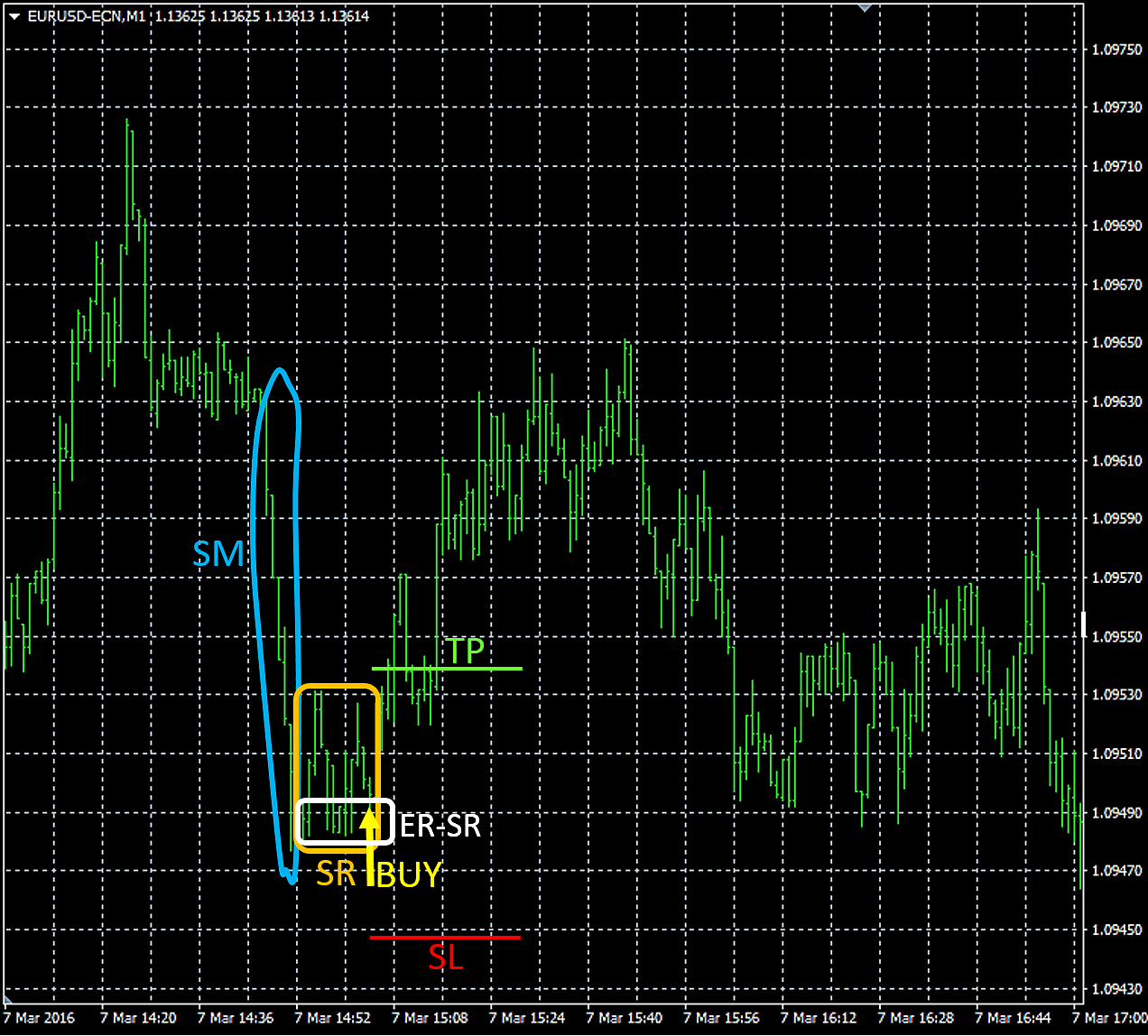
It is recommended to open the attached image resp. figure in a separate browser tab etc. for a better understanding when reading the detailed description below.
Description in detail:
Stage 1:
The fx chart resp. price makes a strong up(sell.order) / down(buy.order) movement for at least n bars. A strong movement (SM) must be calculated as follows:
SM = [(Difference in points between the highest high and the lowest low of the last n closed bars)/n]/[SUM(length of n bars)]
In the Indis GUI the user must also be able to define the minimum value for SM:
-> Minimum value of SM: 0.55 [etc.]
-> Minimum number n of SM bars: 5 [etc.]
If e.g. SM = 0.60, the strong movements bars overlapping value must be averagely maximum 40 %.
If e.g. SM = 1.00, the strong movement consist of consecutive, averagely non-overlapping bars.
If e.g. SM > 1.00, the strong movements bars MUST have partly gaps between each other.
The indi must permanently scan the charts last n closed bars and recognize if all conditions for a valid SM are fulfilled.
Once a SM is detected the indi must note the value resp. price of SMs lowest low and highest high and their positions (time/date). From then on the indi must continually check resp. recalculate if the movement stays strong (definition see above) when including the follow-up bars n+1, n+2, n+3, , n+x (instead of calculating only with n) and ONLY IN THIS CASE update the values/dates for SMs lowest low and highest high (see above).
Furthermore a potential SM(n) resp. SM(n+x) must be ignored by the indi if it exceeds maximum points of distance SM or undercuts minimum points of distance SM, whereby distance = difference between the highest high and the lowest low of all SM valid closed bars (n+x):
-> Maximum points of distance SM: 300 [etc. (if TF = M1)]
-> Minimum points of distance SM: 70 [etc. (if TF = M1)]
Stage 2:
The strong movement slows down. This means that the Minimum value for SMs n bars: 0.55 [etc.] is undercut by the currently closed n+x+1 bar e.g. SMs calculated current actual value shrinks from >0.55 to 0.54 or 0.43 etc. In this case the indi must make the final notation of SMs lowest low / highest high (see above) BUT EXCLUDING the last closed bar that caused the end of SM!
Now the bars of SM consist of the initial bar (IB) followed by n-1 bars + x bars that let the movement stay strong (x can also be 0!) including the final SM bar (FB), before SM is terminated by the terminating bar (TB) which already belongs to the support/resistance area (SR), see below.
Stage 3:
The strong movement (SM) is per definition followed by a support/resistance area (SR). Now the indi must check if at least the next k closed bars within SR starting with TB (see above) are fulfilling the following conditions:
1.) The difference of SRs k bars highest high and lowest low must be a maximum percentage (SR-MP) in relation to SM:
-> Maximum value for SR-MP: 0.35 [etc.]
-> Minimum number k of SR bars: 5 [etc.]
If e.g. SR-MP = 0.35, the k bars in the support/resistance area (SR) are all swinging within a range of maximum 35 % in relation to the strong movements (SM) distance [calculated according to Stage 1).
2.) At least e bars of the k closed bars (within SR, see above) have a high(sell.order) / low(buy.order) that is close to the highest.high(sell.order) / lowest.low(buy.order) of SM-SR, whereby SM-SR includes ALL closed bars starting with IB (initial bar of SM) and ending with the last closed CURRENT bar. Said e bars upper/bottom extrema [high(sell.order) / low(buy.order)] must be in a specified range [in points]; for example 2 bars out of 5 within SR are close to each other AND close to said extremum of SM-SR:
-> Maximum range of SRs e bars: 10 [etc.]
-> Minimum number e of SR bars with similar extrema: 2 [etc.]
If Minimum number e of SR bars with similar extrema = 0, there MUST NOT be any couple/triplet etc. of bars with similar extrema but CAN BE.
3.) At least the l last closed bars of k are lower(sell.order) / higher(buy.order) OR EQUAL to the corresponding extremum of SM-SR:
-> Minimum number l of SRs last bars with lower/higher extremum: 2 [etc.]
If Minimum number l of SRs last bars with lower/higher extremum = 0, the last closed bars within k have no further restriction at this point.
NOTE:
If not all conditions of Stage 3 are fulfilled at the close of bar k, the indi must continually check resp. recalculate them with bars k+1 (instead of k), then k+2 (instead of k+1), then k+3 (instead of k+2), and so on. This process will end if
a) all conditions are fulfilled
or
b) Maximum value for SR-MP is exceeded by the currently processed bar.
If b) occurs the indi must go back to resp. start again with Stage 1.
If a) occurs the indi must proceed with Stage 4 (see below).
Stage 4:
If all conditions of Stage 3 are fulfilled the indi must wait until the current price reaches the end region of SR = ER-SR. The ER-SR is per definition located in the upper(sell.order) / bottom(buy.order) area of SR and finally ending with the SRs highest.high(sell.order) / lowest.low(buy.order). ER-SR must be set in the GUI by the user as a percentage of the distance between the highest high and the lowest low of SR:
-> ER-SRs percentage for entry price level: 0.25 [etc.]
In this case the current price must reach the top(sell.order) / bottom(buy.order) 25% of SR to fulfill this condition.
If said value is set to e.g. 1.25 (= 125%) the current price must exceed(sell.order) / undercut(buy.order) SRs highest.high(sell.order) / lowest.low(buy.order) with a distance of at least 25% SR, whereby distance of SR = highest.high - lowest.low of the current/actual SR in points.
This means that all values above 1.00 result in an price must exceed(sell.order) / undercut(buy.order) a special price level that lies OUTSIDE SR. This calculation is NOT the same as for values between 0.00 and 1.00, because the latter values result in an price must reach specific area.
NOTE:
Its very important that all follow-up bars after Stage 3 resp. while Stage 4 must apart from that ALSO be in the range of Maximum value for SR-MP [see Stage 3: 1.)], even the currently processed (not closed) bar!
As soon as a (current) follow-up bar of Stage 4 exceeds Maximum value for SR-MP before reaching ER-SR (see above) the indi must go back resp. start again with Stage 1.
Stage 5:
If all conditions of Stage 4 are fulfilled the indi must draw a colored down(sell.order) / up(buy.order) arrow above/below the current price reaching ER-SR (see above):
-> Color of the up/buy arrow: yellow [etc.]
-> Color of the down/sell arrow: yellow [etc.]
Furthermore the indi must calculate and draw suggested fixed SL/TP levels (horizontal thin and dotted lines with a length of 20 bars):
-> Color of the fixed SL line: red [etc.]
-> Color of the fixed TP line: lime [etc.]
The value resp. price level of SL/TP must be calculated as follows:
A user defined percentage of the difference highest.high and lowest.low of the whole movement IB->ArrowBar is converted to points and
for SL added(sell.order) to / subtracted(buy.order) from the arrows price level
resp.
for TP subtracted(sell.order) from / added(buy.order) to the arrows price level:
-> SM-SRs percentage for calculating SL buy: 0.35 [etc.]
-> SM-SRs percentage for calculating TP buy: 0.25 [etc.]
-> SM-SRs percentage for calculating SL sell: 0.40 [etc.]
-> SM-SRs percentage for calculating TP sell: 0.20 [etc.]
Furthermore the final SL/TP levels must ALWAYS be expanded by a user set spread (in points) that best represents the brokers average:
-> Spread added to expand TP/SL: 12 [etc.]
Stage 6:
After an arrow and its corresponding TP/SL lines were drawn by the indi the latter must pause all further calculations for the current signal triggering bar AND for r (recess) follow-up bars. After r bars it starts again with Stage 1:
-> Number of recess bars after signal: 10 [etc.]
NOTE: The indi must be 100 % non-repaint and every arrow resp. TP/SL line will stay forever!
Extra filter:
If enabled, all potential sell/buy signals will be skipped if not at least b bars BEFORE SM have a lower.high(sell.order) / higher.low(buy.order) than the highest.high(sell.order) / lowest.low(buy.order) of SM-SR with at least p points difference:
-> Enable extra filter: true/false
-> Minimum number of lower/higher bars b before SM: 100 [etc.]
-> Minimum points of lower/higher bars before SM: 120 [etc.]
!! Please optimize the indicator for the lowest possible CPU usage thx !!
Bewerbungen
1
Bewertung
Projekte
149
36%
Schlichtung
29
3%
/
55%
Frist nicht eingehalten
35
23%
Frei
2
Bewertung
Projekte
120
34%
Schlichtung
17
18%
/
41%
Frist nicht eingehalten
51
43%
Frei
3
Bewertung
Projekte
396
28%
Schlichtung
70
19%
/
49%
Frist nicht eingehalten
121
31%
Frei
4
Bewertung
Projekte
301
30%
Schlichtung
54
24%
/
56%
Frist nicht eingehalten
98
33%
Frei
Ähnliche Aufträge
//+------------------------------------------------------------------+ //| Durban Gold Hunter.mq5 (v3.00) | //| Multi-pair EA for MetaTrader 5 (Razor Markets, XM). | //| Strategy modules (each can be switched on/off): | //| 1. EMA crossover | //| 2. 714 method (EMA 7 + RSI 14) | //| 3. CRT (Candle Range Theory: range sweep and close back inside)| //| 4. Trend line breakout (auto-drawn from swing highs/lows) | //| 5
I want NinjaTrader to behave like Tradovate. When I hover over a candlestick, the cursor should automatically snap to the center of that candle across all open charts. For example, when I hover over a 30-minute candle, the cursor should align with the center of the corresponding candles on the 15-minute and other chart timeframes. I also want vertical lines drawn on one chart to automatically align with the center of
Hello, I already have an MT5 Expert Advisor for XAUUSD based on Fibonacci, market structure, BOS/CHoCH and swing trading. I need an experienced MQL5 developer to modify my existing EA, not develop a completely new one. Required modifications: Partial take-profit system with multiple TP levels. Keep profit targets conservative, using Fibonacci extension levels. Stop-loss placement beyond liquidity areas, not exactly
Hello, I am an independent developer selling an Expert Advisor (EA) on the MQL5 Market. I am looking for an experienced Forex affiliate marketing company or professional marketer to promote my existing MT5 trading robot to customers worldwide. My proposed partnership offers a 35% commission per verified sale, with the possibility of a long-term collaboration. I would like to know: Do you promote third-party MT5
The objective is to develop a custom technical indicator for MetaTrader 5 (MQL5) that replicates the exact visual structure, inputs, and features of the "AYN-Indicator by Snurk" as shown in the provided screenshot. The indicator must analyze price actions based on a flexible lookback period, plot dynamic trend filters, and render precise Buy/Sell breakout labels without any lagging or repainting
Requirements Specification: Debug & Error Fixing: Review the entire source code of the MQL expert advisor. Identify and fix all logical errors, bugs, and performance issues that cause trades to close prematurely or yield extremely low profits. Strategy Restructuring & Optimization: Fully analyze and optimize the current entry and exit strategy for USDJPY and GBPUSD. Modify, upgrade, or completely rewrite the entry
Winter
500+ USD
I am looking for an MQL5 developer to independently review an existing EA’s execution and position management logic. The review should focus on duplicate orders, trade isolation by symbol and magic number, broker price and volume constraints, error handling, and recovery after a terminal restart. This order is for an audit report. Please do not modify the source or change the trading strategy. For each finding
Title: Fully Automatic MT5 Trading Bot (Expert Advisor) with Risk Management I want a fully automated trading robot (Expert Advisor) for MetaTrader 5, written in MQL5. The bot must automatically analyse market data, identify trading opportunities, execute BUY and SELL orders, manage open positions, and close trades according to predefined rules without requiring manual confirmation for each trade. Requirements
The Traffic Rush
250 - 500 USD
Subject: Inquiry: MQL4 Optimization & Refinement for Proprietary Binary Suite (Pine-to-MT4) I am seeking an experienced MQL4 / MetaTrader developer to optimize and finalize a custom binary options trading suite. Project Summary Core Architecture: Multi-pair Regime Scanner (22-pair FX basket monitoring state/score) and a Signal Engine operating on M1 charts. Strategy Sequence: Pre-Alert Dot: Placed on a candle closing
Tradingview pine script bot
30+ USD
Hello I want some that can help with my strategy signal I have the video that you are going to watch if you know you can help me with kindly do well to bid and let discussed it an urgent project and also if you can not work before you get paid please don bid thanks
Projektdetails
Budget
40 - 90 USD
Ausführungsfristen
von 1 bis 4 Tag(e)