Aller Uja / Profil
- Information
|
2 Jahre
Erfahrung
|
12
Produkte
|
3
Demoversionen
|
|
0
Jobs
|
5
Signale
|
23
Abonnenten
|
Ein Multi-Strategie-EA-Portfolio mit diszipliniertem Risikomanagement.
Handel seit 2011 · Algorithmisch seit 2018 · Live-Signale auf MQL5 seit 2024
⚙️ Handelsansatz
- Vollautomatische Strategien (Expert Advisors)
- Multi-Strategie-Portfolio
- Kapitalschutz vor Wachstum
- Kein Martingale / kein Grid / kein Nachkaufen in Verluste
📈 Meine Signale
Aufgelistet im Reiter Signale oben. Jedes arbeitet mit Stop-Loss und festem Risiko pro Trade, und hinter jedem steht eine echte Strategie, die ich selbst einsetze und überwache.
🧰 Meine Expert Advisors
Regelbasierte Systeme, die Sie auf dem eigenen Konto laufen lassen statt zu kopieren — im Reiter Markt oben. Ein harter Stop auf jeder Position, gemessene statt versprochene Zahlen, und eine kostenlose Demo für Ihren eigenen Strategietester.
🛠️ Meine Tools
MetaTrader-5-Werkzeuge, die ein Konto schützen statt es zu handeln: Stop-Loss-Durchsetzung, Prop-Firm-Regeln, Drawdown-Grenzen, Trade-Audit, lokales Kopieren. Die meisten sind kostenlos.
⚡ Infrastruktur
Professionelles VPS für stabile Ausführung und geringe Latenz.
🔎 Transparenz
Hier gibt es keine Demokonten und keine Backtests, die als Live-Handel ausgegeben werden.
Die vollständige Historie, samt der Verlustmonate: https://technotrader.net
⚠️ Risikohinweis
Handel ist mit Risiko verbunden, und Drawdowns gehören normal dazu.
Handeln Sie nie mit Geld, dessen Verlust Sie sich nicht leisten können.
_______________________________
🔗 Dienste, die ich selbst nutze und empfehle:
🌐 Broker (ICTrading)
https://www.ictrading.com/?camp=83911
📒 Handelsjournal & Analyse (FXer)
https://fxer.net
💱 Code: TECHNOTRADER50 (50% Rabatt für 6 Monate)
🏛️ Prop-Firma (The5ers)
https://www.the5ers.com/?afmc=92n
🧪 Strategie-Inkubator (Darwinex Zero)
https://www.darwinexzero.com/?fpr=y68tgd
💱 Code: TECHNOTRADER_20 (20% Rabatt)
Einige der obigen Links sind Affiliate-Links.
_______________________________
📧 Kontakt
💬 Telegram https://t.me/TechnoTrader28
▶️ YouTube https://www.youtube.com/@TechnoTraderStream
TechnoTrader | Automatisierte Handelssysteme
Folgen Sie den Signalen, betreiben Sie einen EA auf Ihrem Konto, testen Sie die kostenlosen Tools oder fragen Sie auf Telegram.
https://www.mql5.com/en/signals/2338047
📊 On the flagship, 103 weeks, it is exactly its own size: 11% and 11%. Both breakdowns are on the signal pages themselves.
https://www.mql5.com/en/signals/2307342
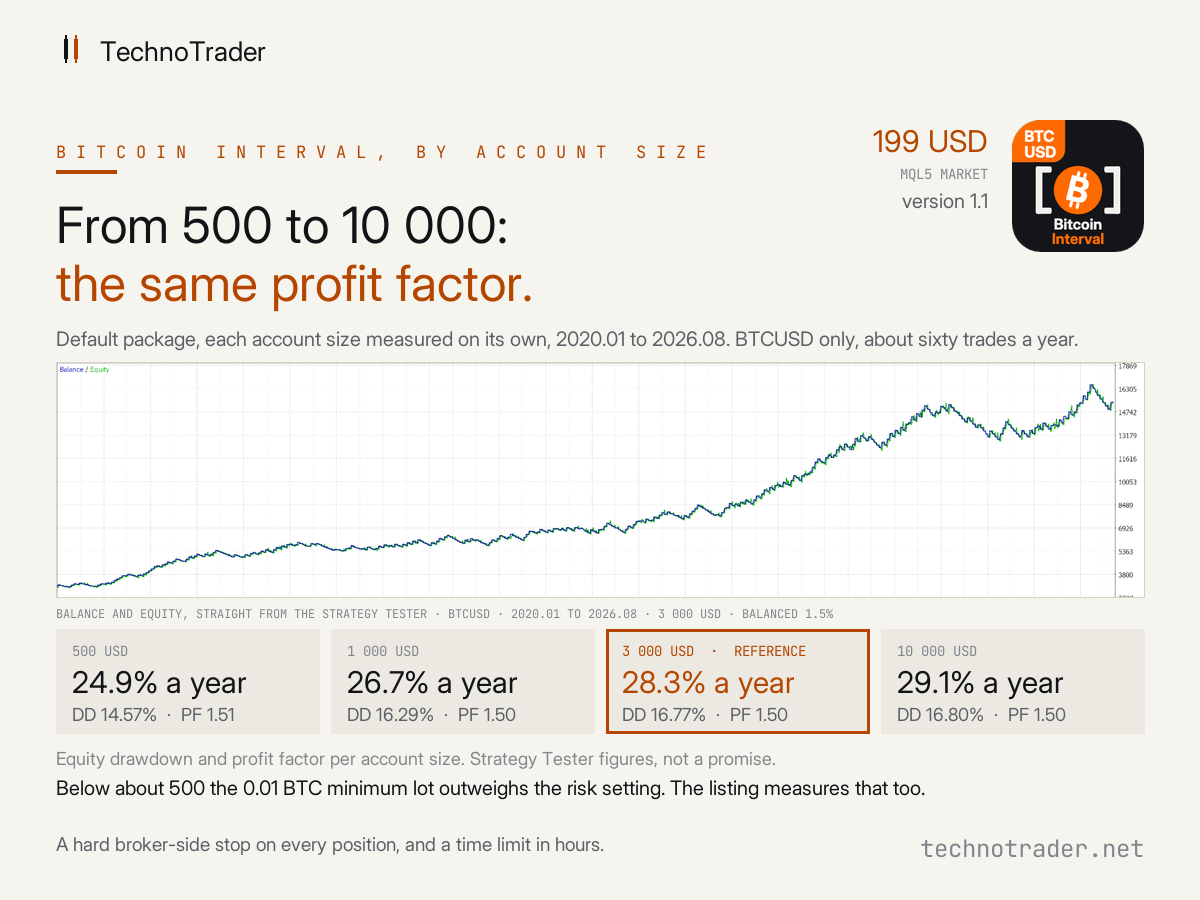
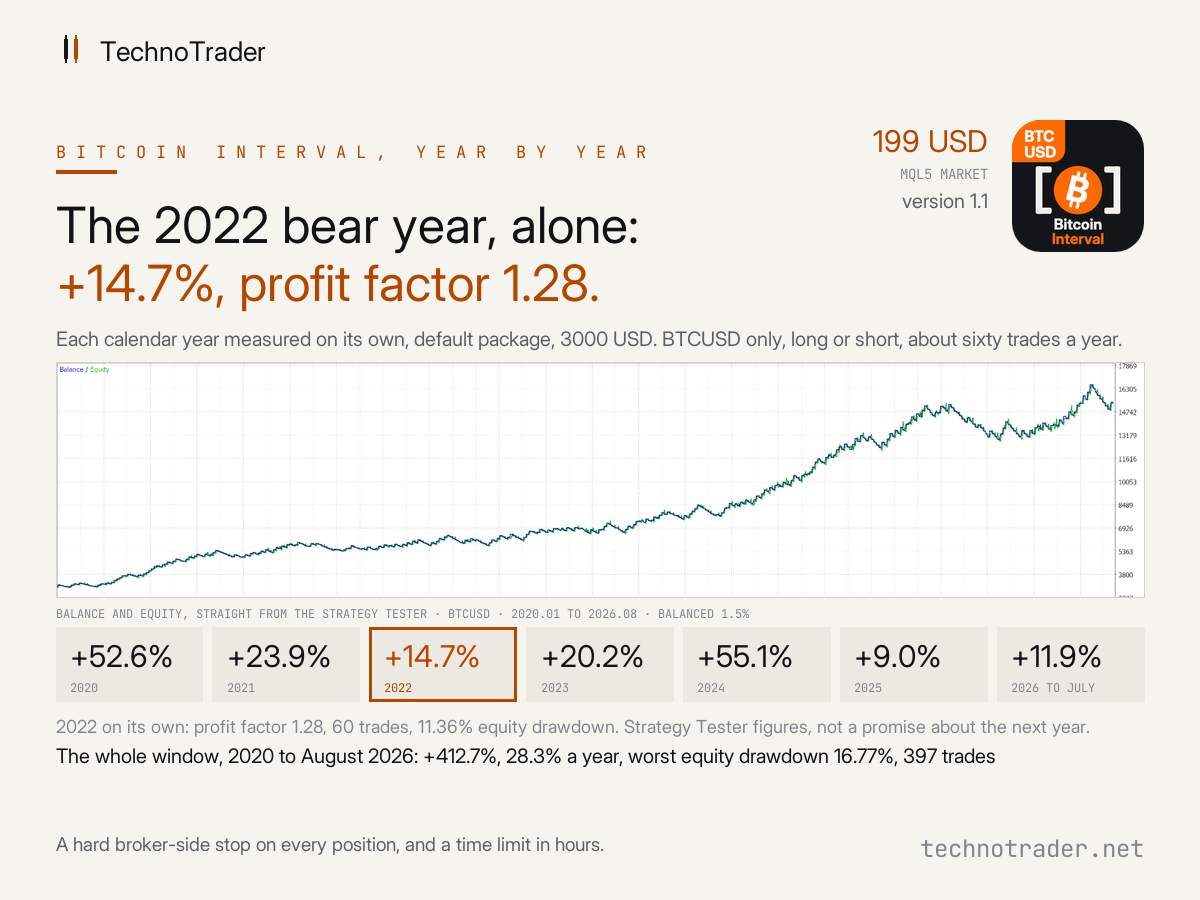
⚙️ Those are the rules that ship as Bitcoin Interval. BTCUSD only, about sixty trades a year, a broker-side stop on every one.
https://www.mql5.com/en/market/product/193069
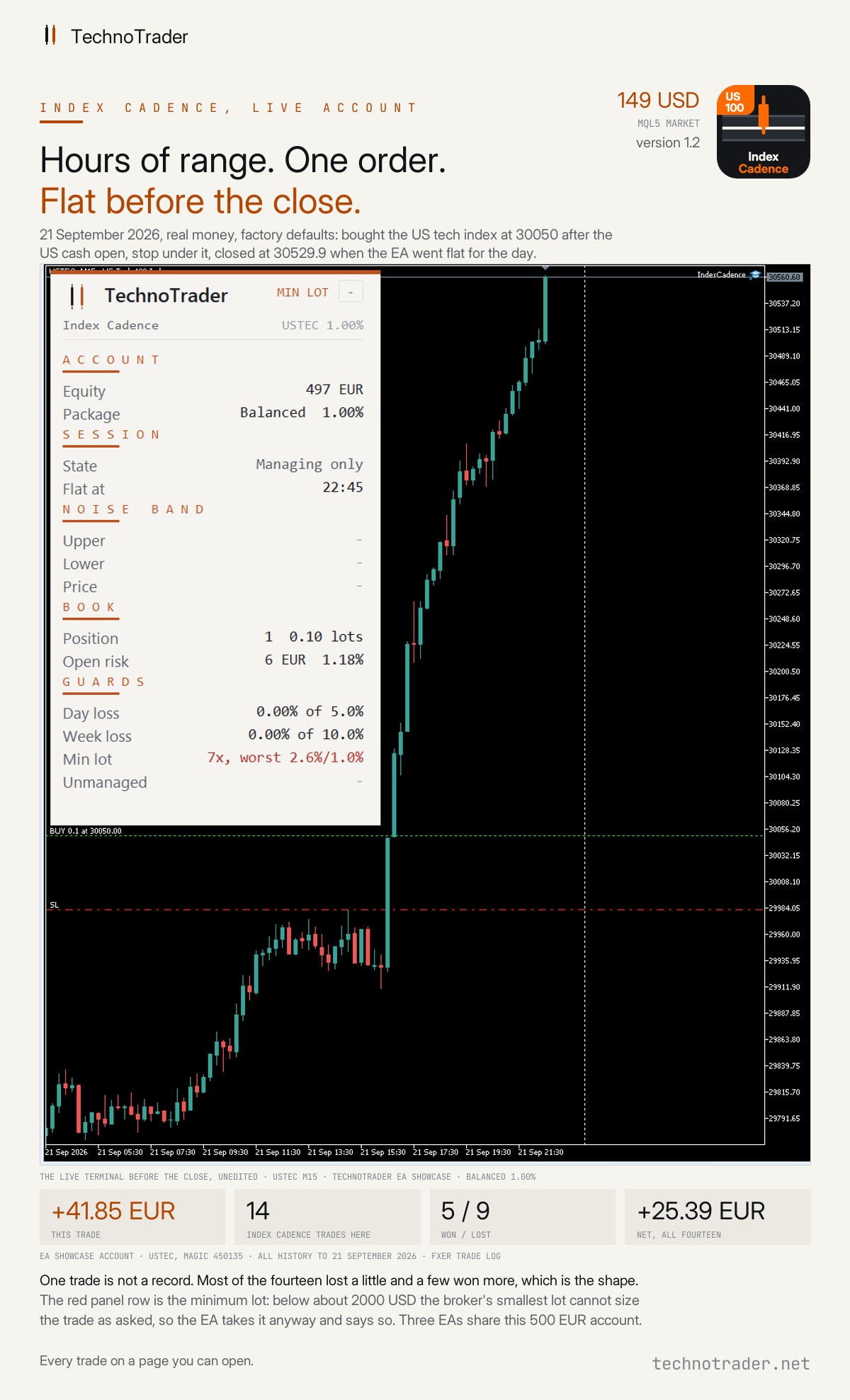
🔍 They run live today on TechnoTrader EA Showcase: three of my EAs on one 500 EUR account. That curve belongs to the three together, not to this product.
https://www.mql5.com/en/signals/2387565
📅 99 USD until Sunday 13 September. Then 199. The measured record, thin years included, is on the product page.
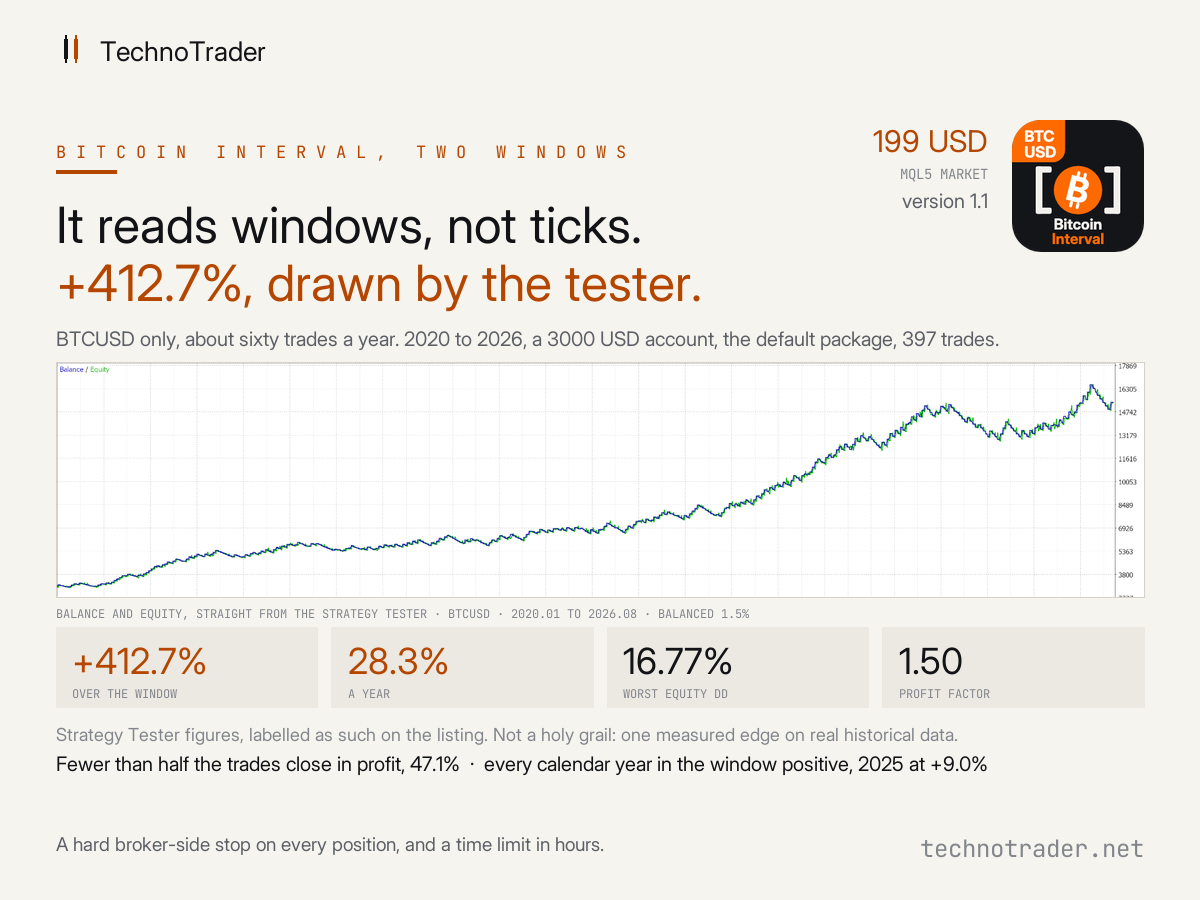
LIVE-SIGNALE - TechnoTrader EA Showcase · Techno Long Term IC · Techno Long Term · Techno Growth Bitcoin Interval handelt ausschließlich BTCUSD, rund sechzig Trades pro Jahr, jeder davon mit einem beim Broker hinterlegten Stop-Loss: 28,3 % pro Jahr bei 16,77 % maximalem Equity-Drawdown, gemessen von 2020 bis 2026 mit den Standardeinstellungen. Das ist kein heiliger Gral. Es ist ein regelbasiertes System: jeder Einstieg, jeder Stop und jeder Ausstieg folgt vorab festgelegten Bedingungen, nichts
⚙️ Bitcoin Interval trades BTCUSD and nothing else. Two calendar-window modules, positions held for hours, about sixty trades a year, a hard broker-side stop on every one.
📈 Start with the part that is not a backtest. These rules have been running in the EA portfolio behind my public signals since 2024.
📊 On Techno Long Term, 103 weeks at Tickmill, Bitcoin is 11% of the deals and 11% of the net profit. On Techno Growth, 46 weeks at Capital Point, it is 15% of the deals and 22% of the profit.
🔗 One mechanism, two brokers, two configurations, and it carries its share on both. The settings are not identical between those accounts, and that is the point rather than a caveat: this is not one lucky setup on one feed.
⚖️ The allocation is deliberately conservative. What the share shows is not how much Bitcoin can earn, it is that these rules have run in public, on real money, for two years.
🧪 The measurement: January 2020 to August 2026, raw-spread feed, 3,000 USD, defaults. 28.3% a year, profit factor 1.50, worst equity drawdown 16.77%, 397 trades.
🔀 The window was split in half before anything was measured and the halves agree: 29.4% against 26.0% a year, profit factor 1.52 against 1.47.
🔍 Thirty mechanisms were measured. Two ship. Four of the rejected ones were breakout designs, all strong before 2021 and weak after. This is the only candidate whose recent half beats its early half.
📉 The cost, published like the good years. 47.1% of trades close in profit, so it loses more often than it wins. 2025 returned 9.0% at a profit factor of 1.17.
📅 Launch price 99 USD until Sunday 13 September, then 199.
⏳ Sixty trades a year, one instrument, every position with its stop already in the market. If that sounds slow, it is meant to.
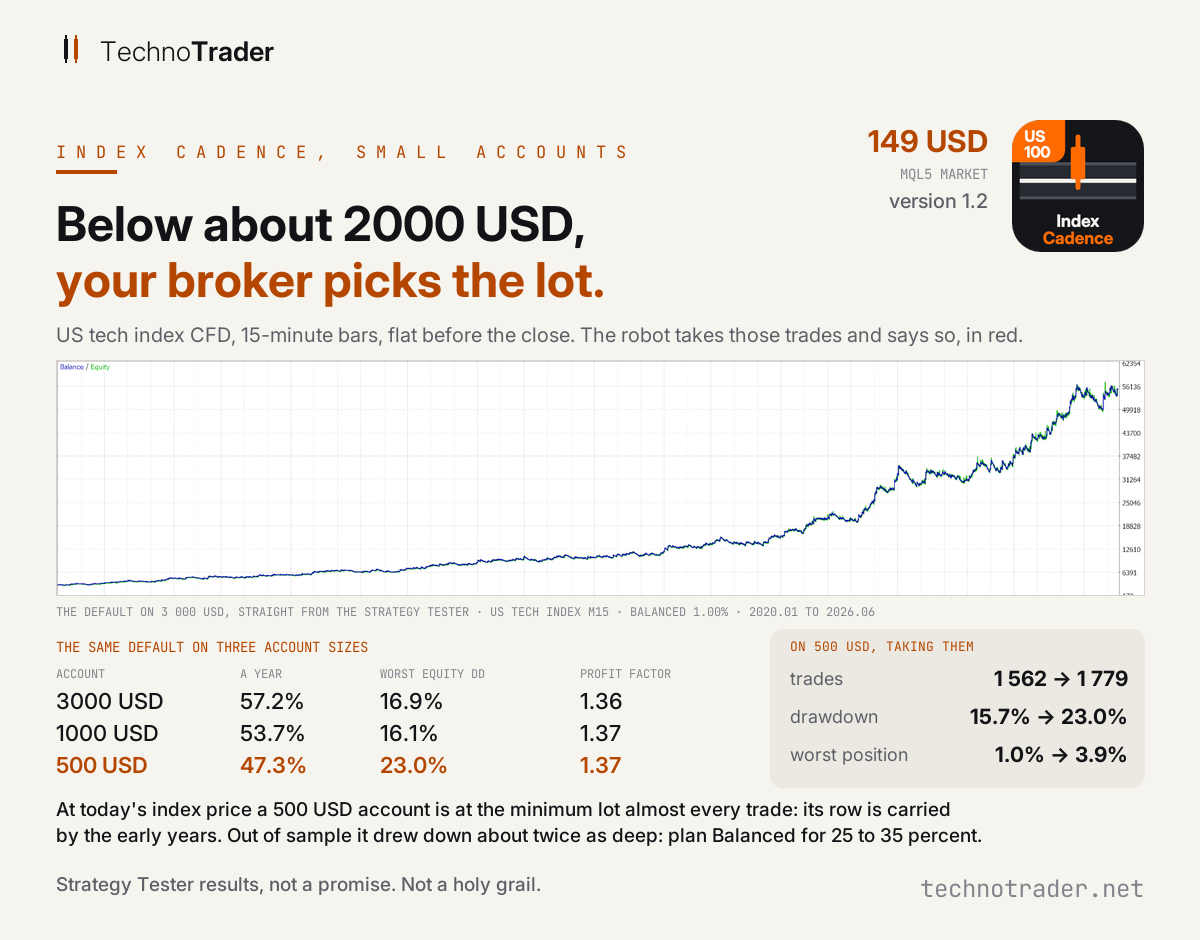
Version 1.0 had a quiet failure. If your broker's minimum lot size would have risked more than your risk setting allowed, the EA skipped that trade. It did not warn you, it did not log it, it just did not trade. On a small account that meant most of the signals it found never became positions, and the only way to notice was to wonder why it was so idle.
Version 1.1 takes those trades by default, at the minimum lot, and tells you exactly what that costs.
Measured on a 500 deposit over the same test window:
Skipping them: 1,562 trades, 15.7% worst drawdown.
Taking them: 1,779 trades, 23.0% worst drawdown.
The return was the same either way. 📊
More trades, a deeper drawdown, no more money. That is a trade-off and not an improvement, which is why it is an input you can switch straight back to the old behaviour. The worst single position risked 3.9% against a 1.0% setting, and the on-chart panel now shows a red row counting how many positions the broker sized and the worst risk any of them carried.
Two other changes in the same version. The three risk packages are now 0.5%, 1.0% and 1.5% per trade with the percentage shown in the dropdown, and Balanced, the default and the published configuration, is unchanged. There is also a fixed-lot package for anyone who would rather set the size themselves.
If you run it on 1,000 or 3,000 with the defaults, the behaviour is identical to 1.0. The change only bites on small accounts, which is exactly where the old silence did the most damage.
https://www.mql5.com/en/market/product/190845
Best single trade: +45.28 EUR.
Worst single trade: -58.93 EUR.
Both out of 4,518 closed trades, and the account is up. Drawn on one shared scale, because zooming either bar would destroy the only thing the picture is for.
This surprises people, and it should not. A system does not earn by landing bigger winners than losers. It earns by winning more often than it loses, at sizes close enough that neither side runs away with the account. 3,131 up, 1,387 down, over 103 weeks. ⚖️
If you ever see a record where the best trade dwarfs the worst one, that is worth a question rather than applause. It usually means either the stops are wide and the targets are far, which shows up later as one very bad week, or the sample is too short to have met its worst trade yet.
Mine has met it. It is on the page, it is the longest bar in this image, and it is one of 1,387.
https://www.mql5.com/en/signals/2307342
The live account behind the EA opened on 20 August. This is everything it has done so far: 3 closed, 0 up, 3 down, equity 482.73 EUR on a 500 EUR start.
MQL5 itself puts three warnings on that page, and it is right about all of them. The number of deals is too small to evaluate trading quality. It is a newly opened account and results may be of random nature. Trading activity is low.
So this is not a result, and I am not presenting it as one. Three trades is noise. 🎲
I am posting it because the account is public either way. It is linked from the product page, it will still be there in six months, and anyone can open it in ten seconds and count. An account that only gets mentioned in the months it is up is not evidence of anything, it is marketing with a chart attached.
The reason it exists is simple: the EA is priced at 199 and I did not want to sell it on a backtest alone. So there is a real account, running the default settings, in public, from day one. Some weeks that will look good. This week it looks like this. ⚖️
Come back in a year and the sample will mean something. Right now the only honest thing on that page is the warnings.
https://www.mql5.com/en/signals/2387565
All three of these are on my signal page right now. All three are correct. They are answers to three different questions asked of the same account.
Maximal drawdown — 30.85%
The deepest fall from a peak, measured in money.
Relative drawdown by balance — 38.63%
The same kind of fall, measured against the balance at the time.
Relative drawdown by equity — 13.77%
Measured against equity, so it includes what open positions were worth at that moment.
🔍 Why this is worth knowing before you read anyone else's page
A seller who quotes only the smallest of these is not lying. The number is on the platform, the platform computed it, and it is real. But the choice of which one to print is a decision, and the decision tells you something the number does not.
The gap here is nearly three to one. Someone reading 13.77% and someone reading 38.63% are picturing two different accounts, and both are picturing mine.
📌 Which one I use, and why
I quote the 30.85%, because that is the one that actually hurt. It is the fall a person copying this account would have lived through, expressed against the money that was there when it happened. It is also the largest number I could reasonably print, which is exactly why it is the one worth trusting from anybody.
The habit worth taking from this is small and it works on every signal page, not only mine: when someone hands you a drawdown figure, ask which of the three it is. If they do not know, they are quoting rather than measuring. If they do know and picked the flattering one, that is worth knowing too.
The whole record, all three rows on the same page: https://www.mql5.com/en/signals/2307342
Figures as the page reads today: 4,497 trades, 3,118 wins and 1,379 losses, profit factor 1.31, 103 weeks live.
Every listing I have opens with what the tool refuses to do, so this one may as well too. None of these decides what to trade. They guard, measure and copy what something else already decided.
🛡️ RISK SENTINEL — free
A hard stop on every position, break-even, trailing, and a daily-loss breaker.
Opens no trades. Never leaves one naked either.
📉 DRAWDOWN FLOOR — free
Plots equity against the trailing, static and daily floors, and marks the binding one.
Equity history starts at the bar you attach it. Never a faked backfill.
🔍 TRADE AUDITOR — free
Reads your own history and names martingale, grid and averaging down where it finds them.
Sends no orders, so it needs no trading permission.
🚪 ORDER GATEHOUSE — free
Entry and position management on the chart's own symbol, from a click panel.
No virtual or hidden stops, ever. No Strategy Tester trading.
🔗 COPIER RELAY CORE — free
Copies MT5 to MT5, rebuilding stops from entry on the receiver's own fill.
No MT4 side. No remote or cloud copying. Both terminals on one machine.
🏛️ PROP GUARDIAN — 49 USD
Keeps a funded or challenge account inside its daily and overall limits.
A protection tool, not a strategy. Firm presets are starting values to check, not gospel.
🔥 MARTINGALE FIREWALL — 49 USD
Decides whether a bigger lot after a loss is a martingale step, and stops it.
Opens no trades. It runs alongside whatever does.
🔗 COPIER RELAY — 49 USD
The paid tier of the same copier engine, not a different one.
Still one machine, still no MT4, still hedging accounts only.
📌 Two things worth saying plainly
Five of the eight are free, and the free ones are not crippled builds waiting for you to pay. They are finished tools. The paid three are paid because they are larger, not because the free ones were deliberately hobbled.
And none of them opens a position you did not ask for. That is the whole category: a layer around the account rather than a thing that trades it. If you already have a strategy you trust, these are what keep an ordinary bad afternoon from turning into an account-sized one.
All eight are on the Market tab: https://www.mql5.com/en/users/aller.techno/seller
The live broadcast is not a schedule. It comes on when the terminal is doing something and it goes off when that is finished, which is why last week has a fifty-second session in it and a four-hour one, and no Saturday at all.
MON 17 — 16m00s · 0m50s · 21m45s
TUE 18 — 1h00m · 0m35s
WED 19 — 7m35s · 2m00s · 59m25s
THU 20 — 4m30s · 6m50s · 2m50s
FRI 21 — 4h18m
SUN 23 — 10m15s
🔍 The part worth noticing
The two longest broadcasts of the week held both ends of it. Wednesday's fifty-nine minutes produced the best result of the week. Friday's four hours and eighteen minutes produced its only loss.
That is the opposite of the tidy version, where a long session means a good one and you switch off when it turns. The broadcast length is not a signal about anything. It is simply how long the system had something open.
📌 What the stream is actually for
It is not education and it is not entertainment. There is no commentary because there is nothing to explain: a condition was met or it was not.
What it does provide is the one thing a screenshot cannot. A timestamp, a terminal, and a broadcast that was running whether or not anybody was watching. Anyone can post a good day after the fact. Very few will let you watch the ordinary ones, including the four-hour Friday that ended down.
This week's 58-second proof video, cut from three moments in those thirteen sessions, is on the channel: https://www.youtube.com/@TechnoTraderStream
The account those sessions are trading, including the months I would rather not show you: https://www.mql5.com/en/signals/2307342
Every trade this account has ever made, measured against the account itself. The account is 2,342.32 EUR.
Average winning trade — 3.06 EUR, 0.13% of the account
Average losing trade — 5.28 EUR, 0.23%
Best trade in 4,480 — 45.28 EUR, 1.93%
Worst trade in 4,480 — 58.93 EUR, 2.52%
Not one trade in four and a half thousand ever moved this account by three percent. The best one it ever had is worth about fifteen average wins, and it changed nothing that a quiet week would not also change.
🔍 Why I keep drawing this one
When someone shows you a track record, the single most useful question is not how much it made. It is how much of the result depends on a handful of trades.
A curve carried by three outliers is a curve that has to hope those three keep arriving. You cannot see that from a growth percentage. You can see it instantly from a chart like this one: if the best trade is a visible step in the equity curve, the record is a bet on that step repeating.
Here it is not visible, because at 1.93% of the account it cannot be. The result is 4,480 small events, roughly seven in ten of them positive, none of them decisive on its own.
📌 What it costs to be built this way
Everything. This is exactly why the account grows in the unremarkable way it does, why the expected value of a single trade is fifty cents, and why the honest answer to "what did it do this week" is usually "not much". There is no version of this where the curve is smooth, the trades are small, and the returns arrive quickly.
That trade-off is the product. A record with no hero trade in it also has no single trade whose absence would have broken it, and that is the property I want when the next unusual month arrives.
The whole record, including the months I would rather not show you: https://www.mql5.com/en/signals/2307342
Figures as the page reads today: 4,480 trades, 3,105 wins and 1,375 losses, profit factor 1.31, 102 weeks live.
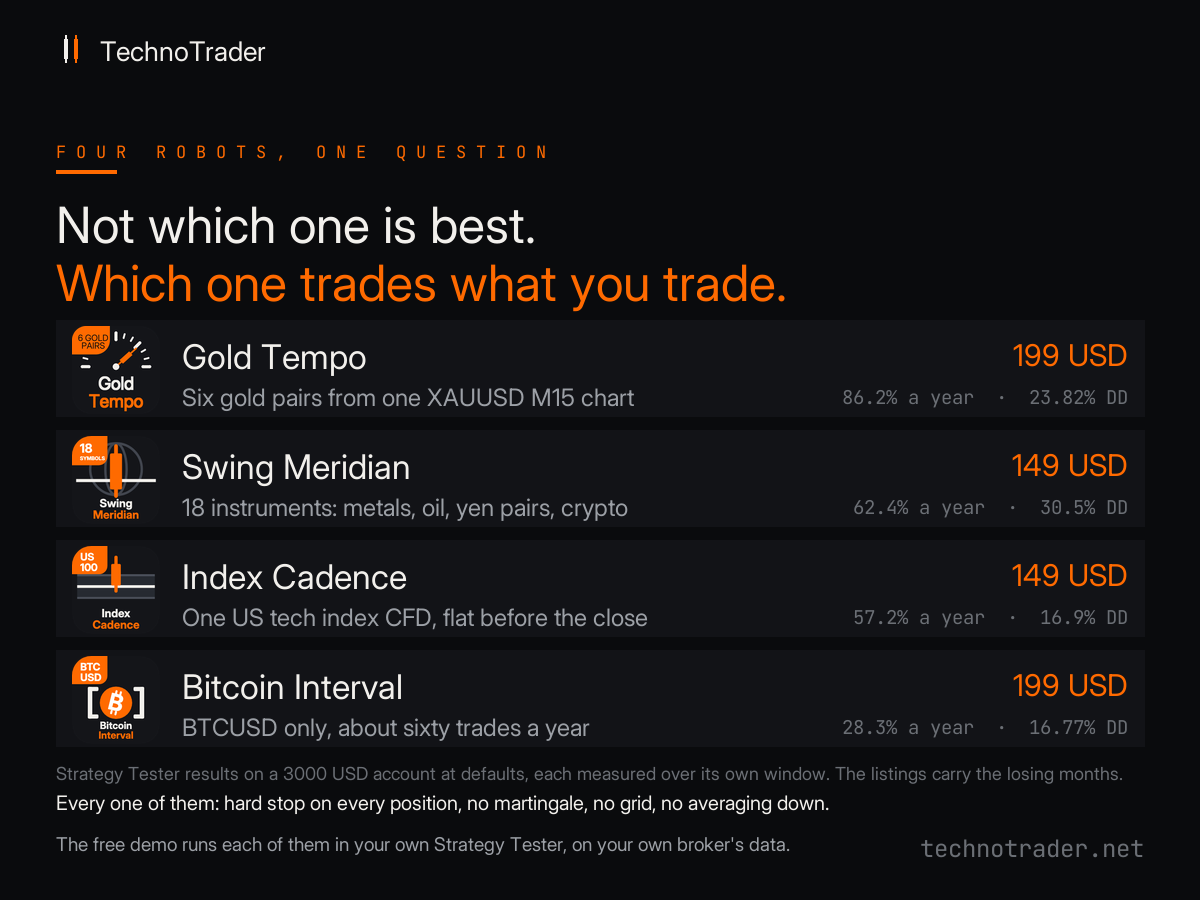
I get asked which one is the best. That is the wrong question, and the honest answer is that none of them always works and none of them was meant to. What each one does have is a set of rules written down before it was tested, measured on the same terms as the other two, and published with what it costs as well as what it returned.
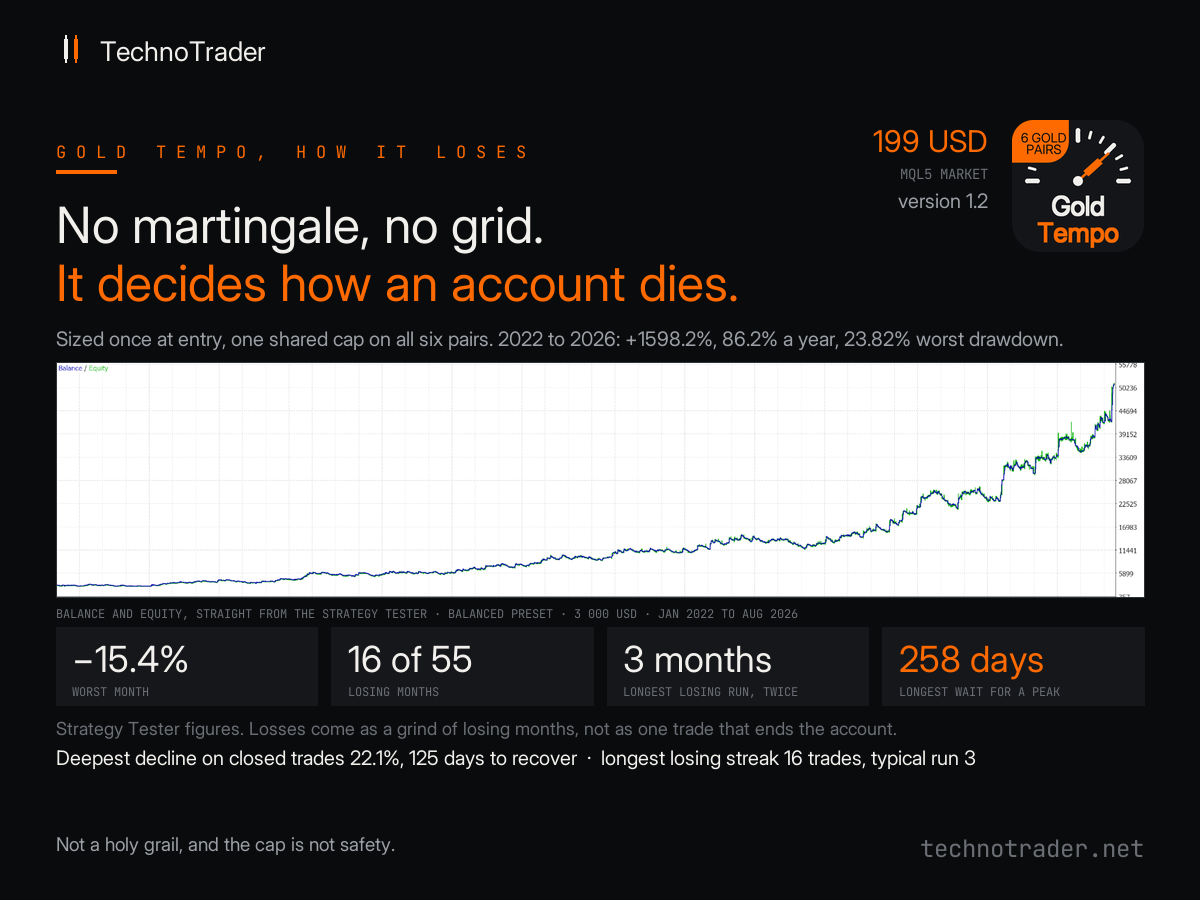
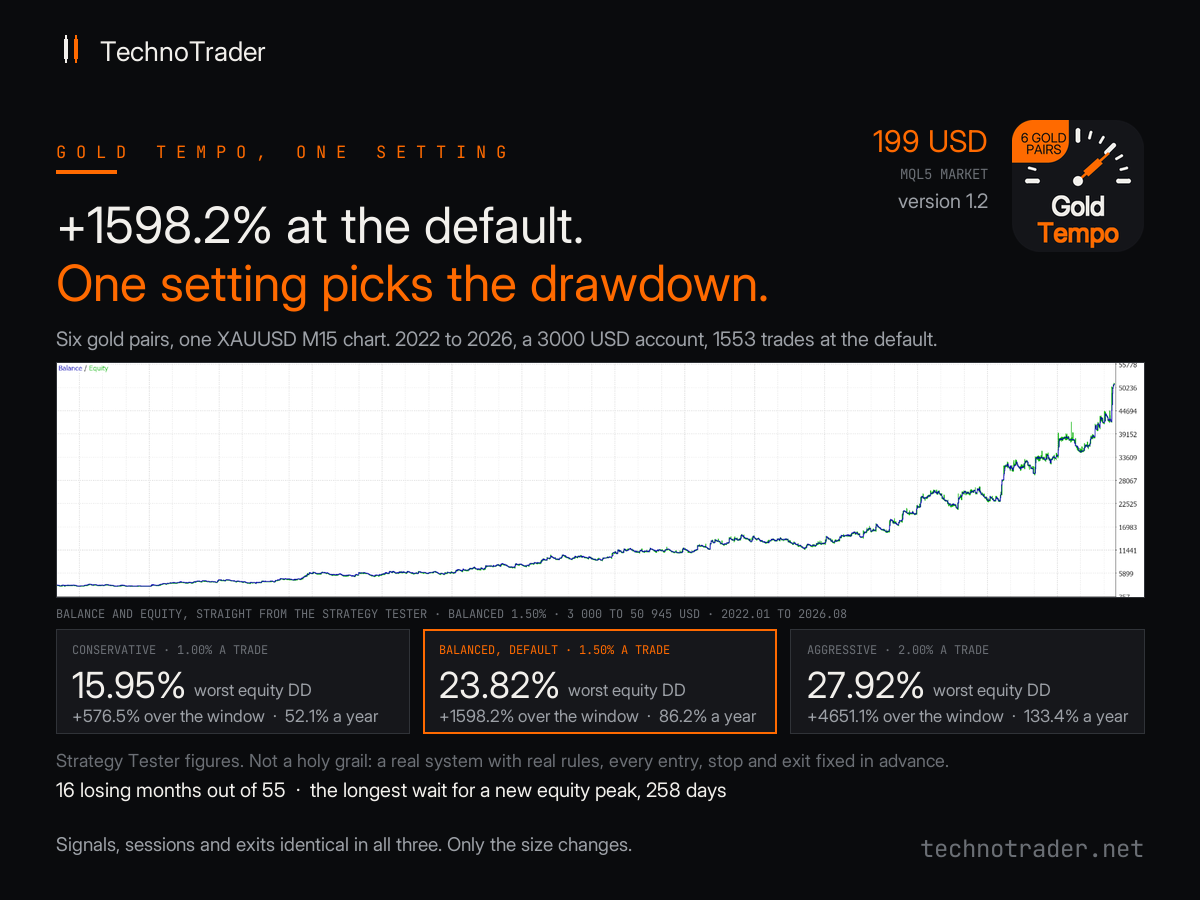
🥇 GOLD TEMPO — 199 USD
Six gold pairs from one chart. Positions held about two hours, nothing left open overnight.
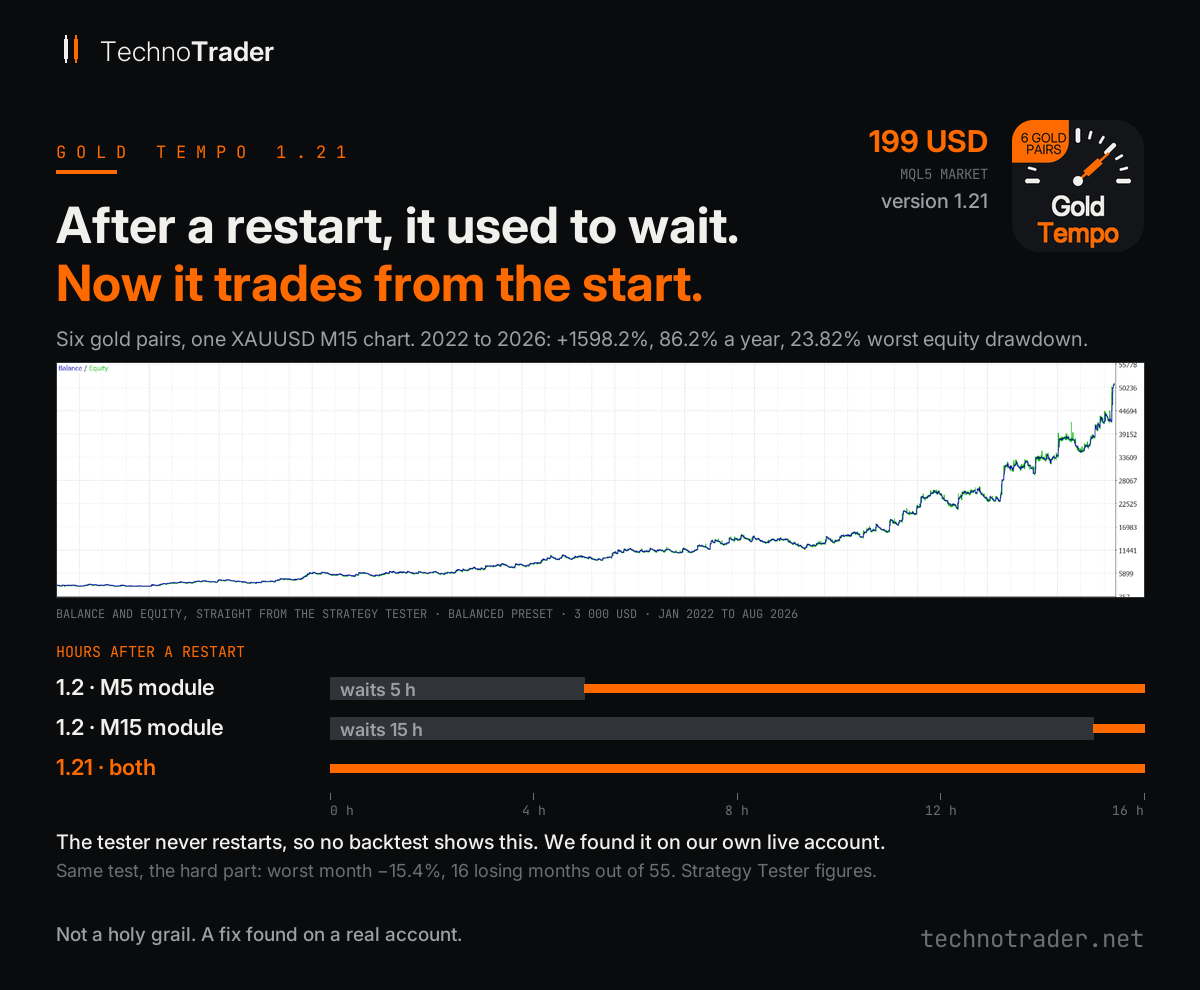
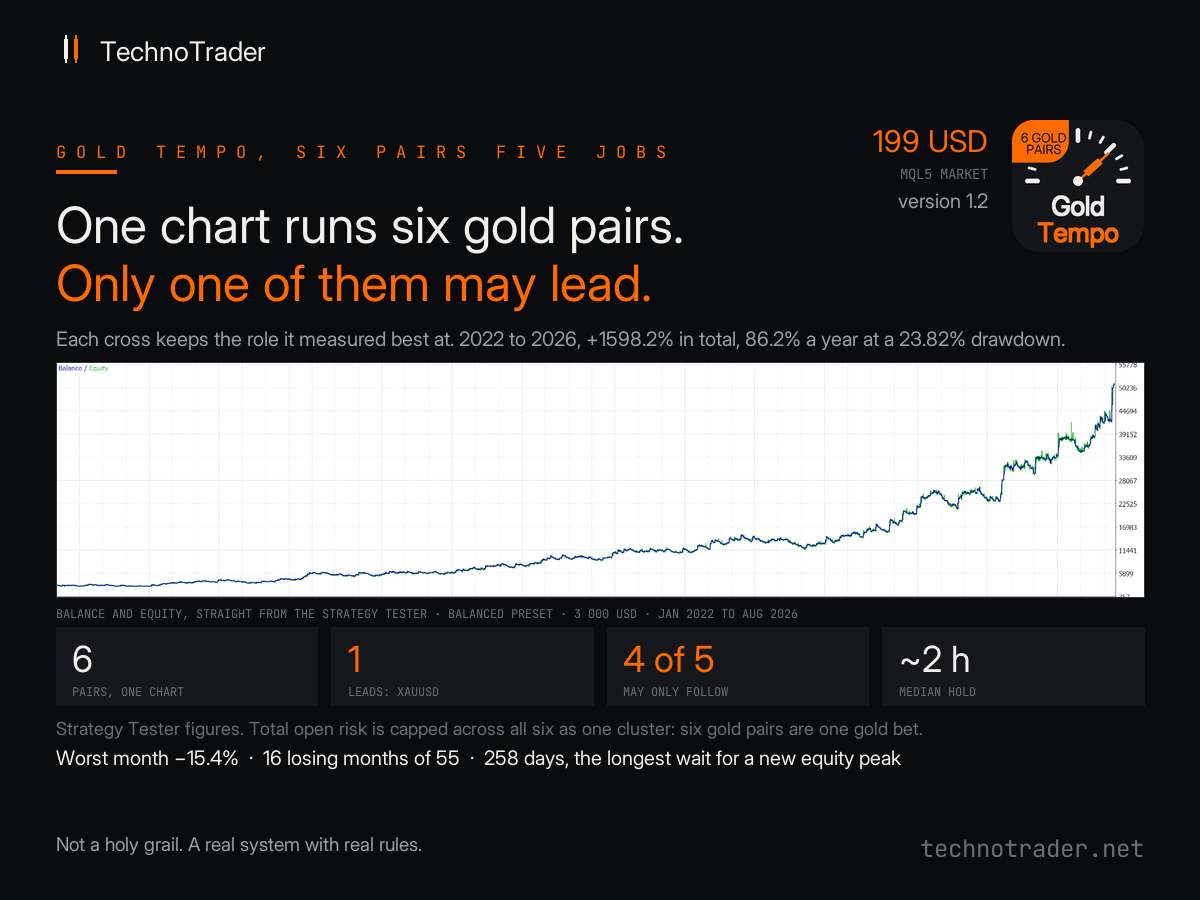
+1442% total · 82% a year · 23% equity drawdown · 2022.01-2026.08
The honest part: 16 of those 55 months lost money.
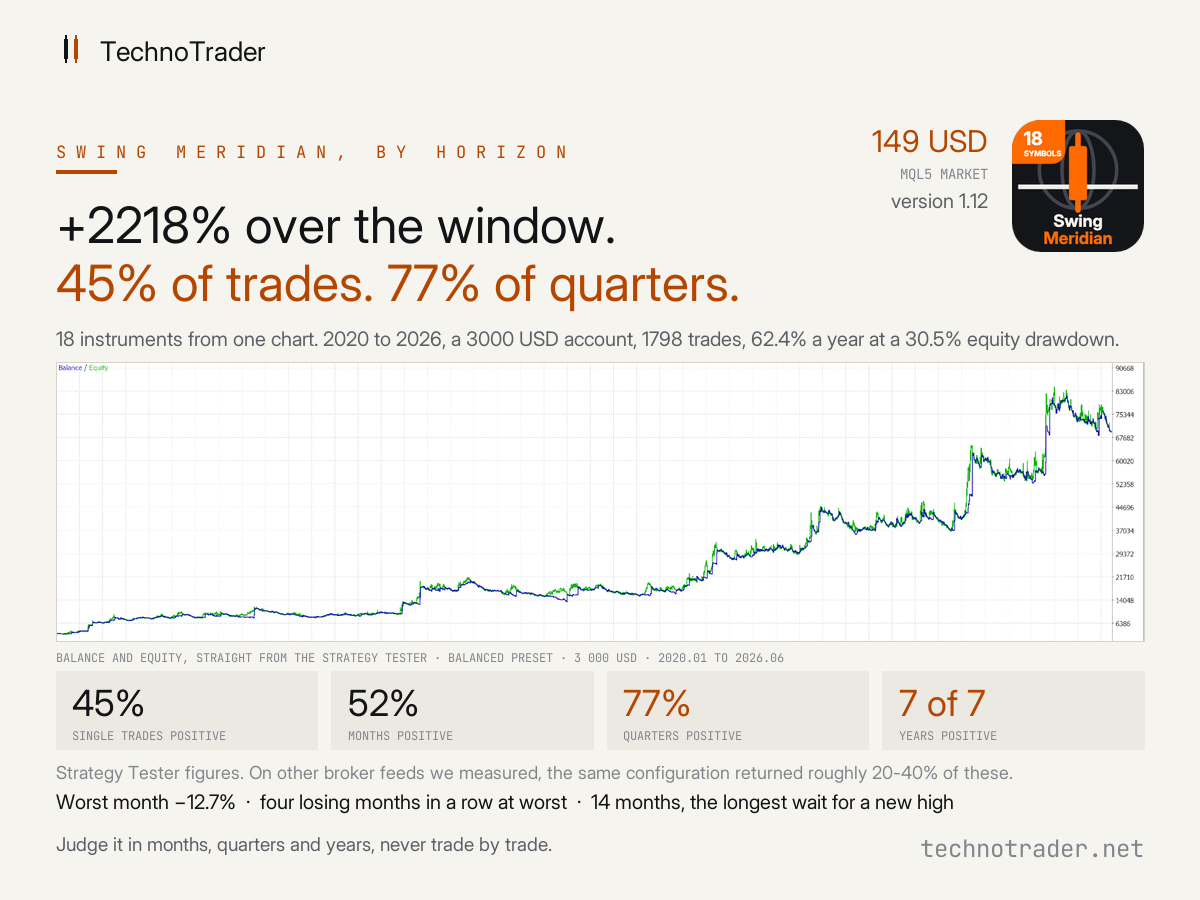
📊 SWING MERIDIAN — 149 USD
Eighteen instruments. Positions held from a day to about a month.
+2218% total · 62% a year · 31% drawdown · 2020.01-2026.06
The honest part: one start date in nine ended its first year negative.
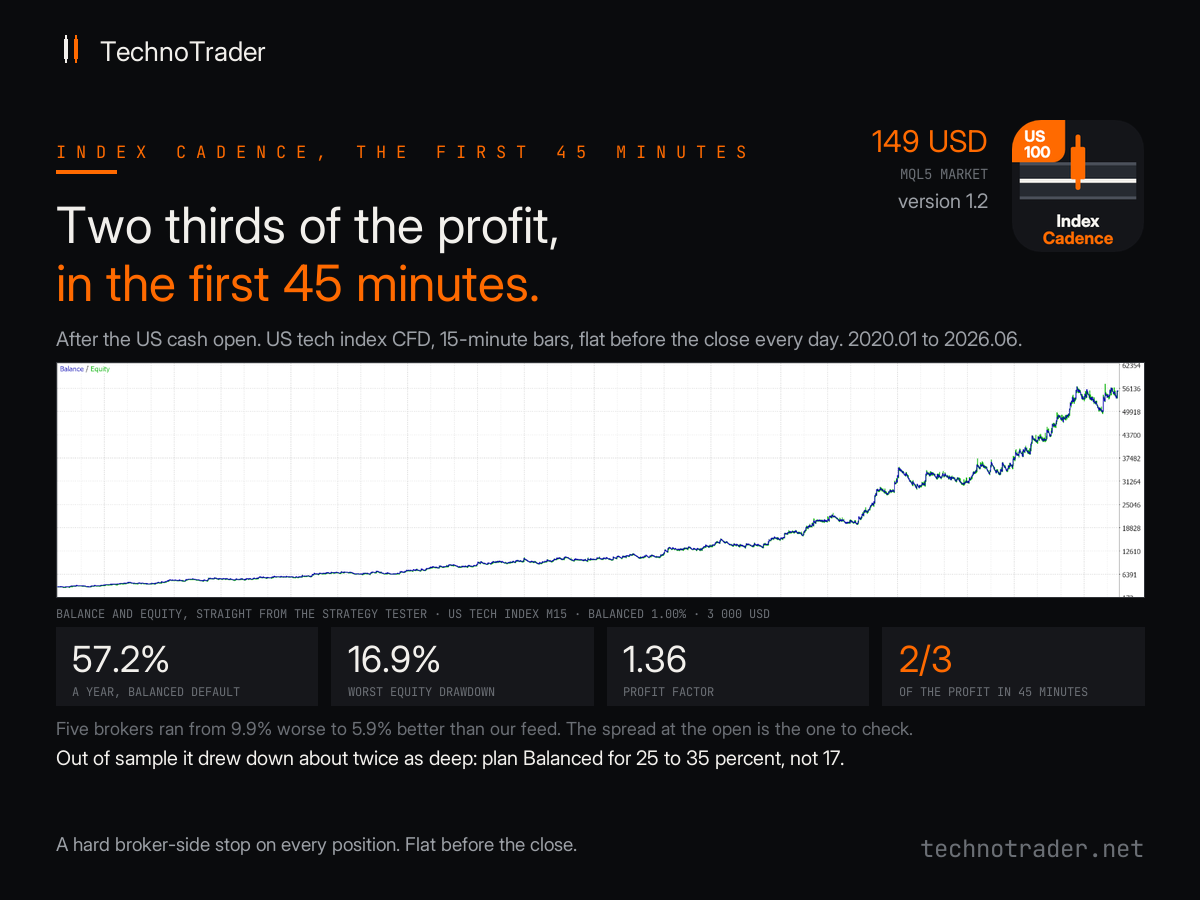
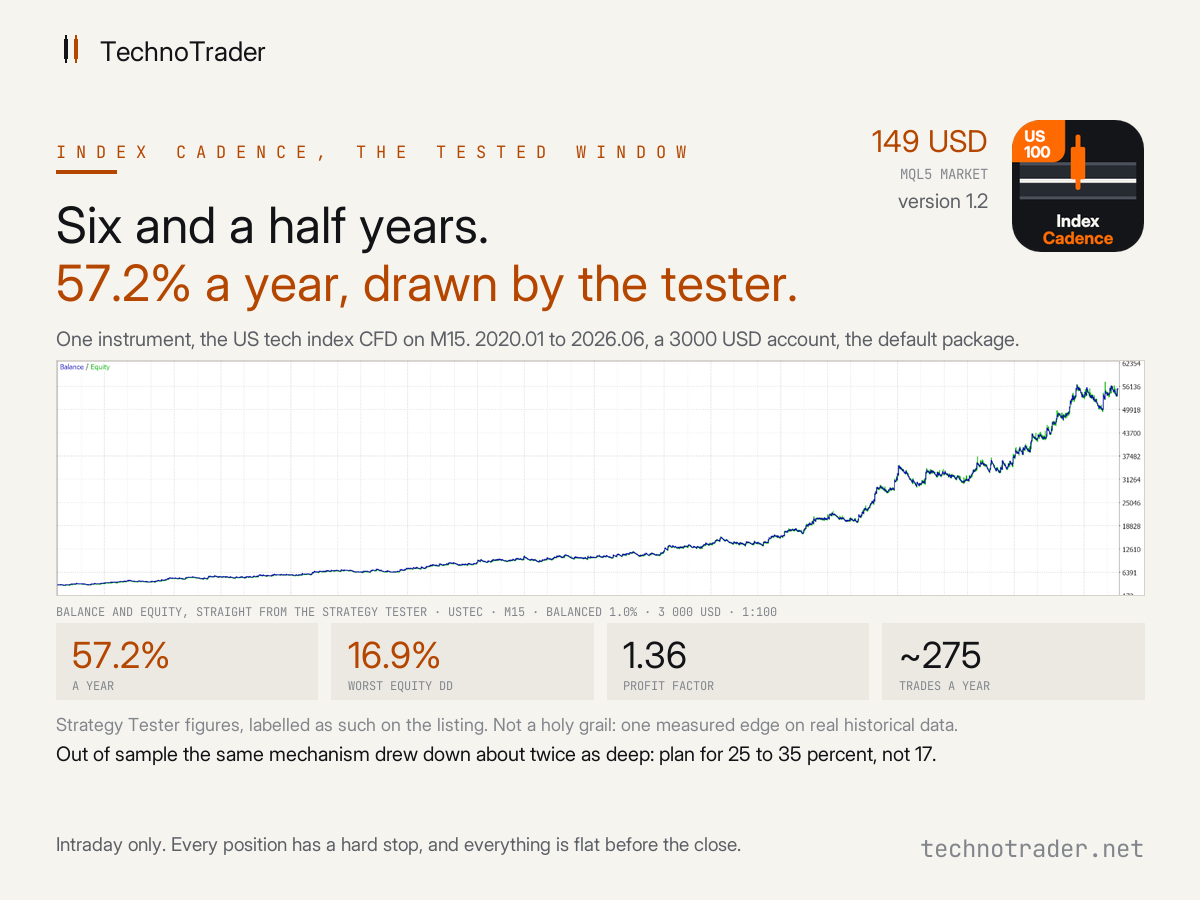
⚡ INDEX CADENCE — 149 USD
One instrument, the US tech index. Flat by the end of every day.
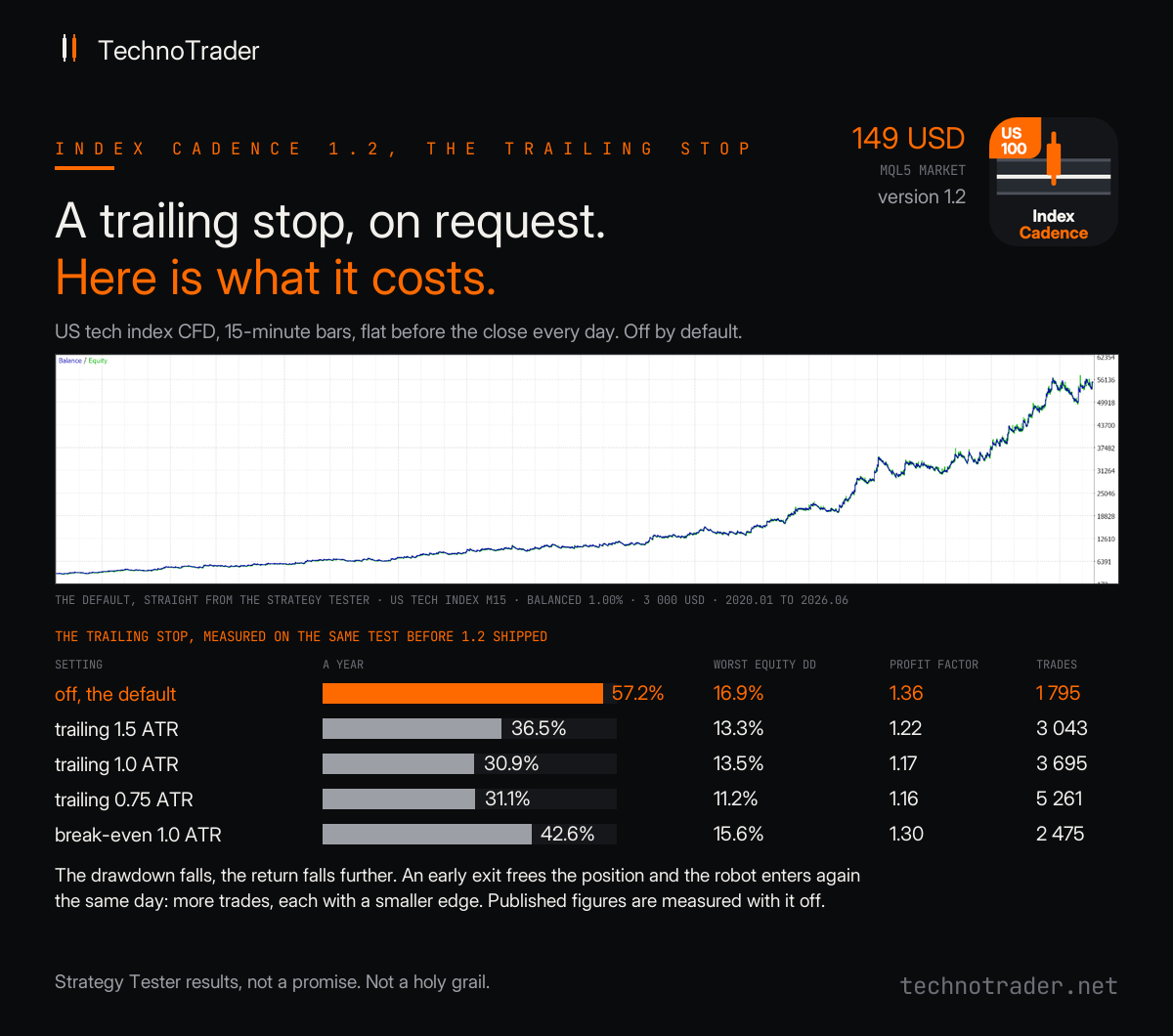
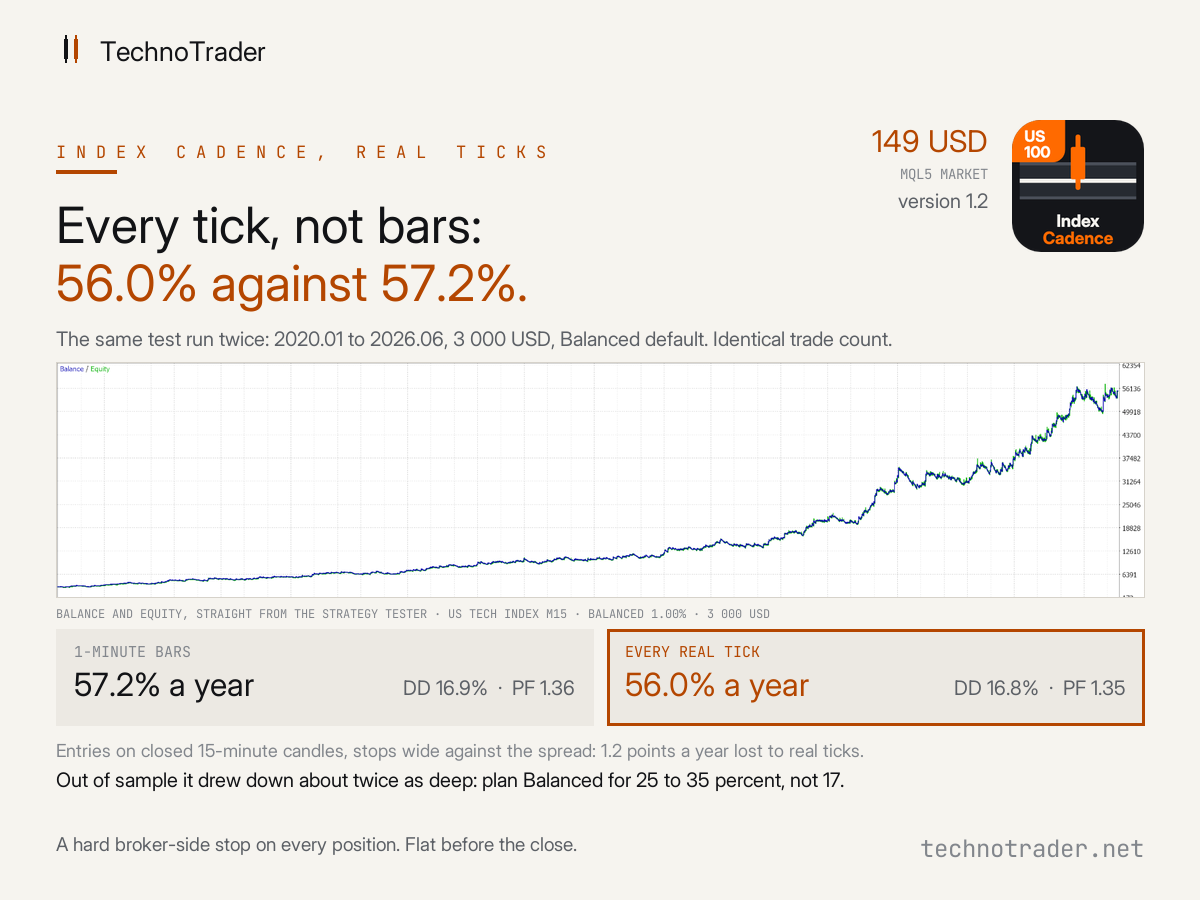
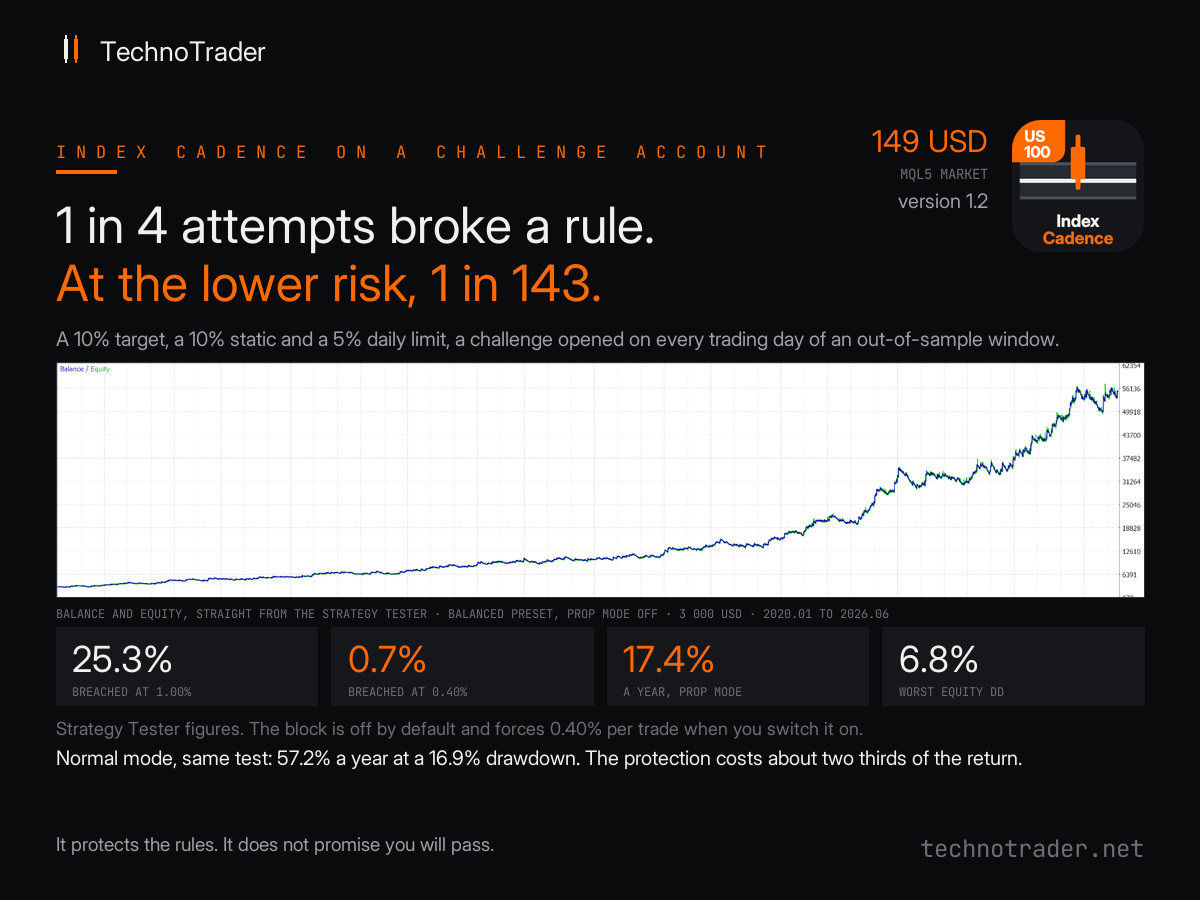
+1776% total · 57% a year · 17% drawdown · 2020.01-2026.06
The honest part: out of sample the same mechanism drew down twice as deep, so plan for 25 to 35 percent rather than 17.
⚠️ Read those totals carefully. All three are the default package on a 3000 USD account, but the three windows are not the same length. Gold Tempo earned its figure in four and a half years and the other two in six and a half, so the totals do not compare, and that is exactly why the yearly rate sits next to each one. A total without its window is a number you cannot use.
Return and drawdown are printed at the same size everywhere I publish them, because one of those numbers is the price of the other.
They are also not one engine with three names on the box. They trade different instruments over different horizons and they hurt in different ways. Gold Tempo hurts through a run of losing months. Swing Meridian hurts through a long wait for a new equity high. Index Cadence hurts through a win rate under half, where being wrong more often than right is the normal state and not a warning sign.
Whether their bad stretches actually land on different months is something I have not measured across the three, so I am not going to sell you a diversification argument I cannot show you.
Gold Tempo, 199 USD: https://www.mql5.com/en/market/product/191673
Swing Meridian, 149 USD: https://www.mql5.com/en/market/product/190521
Index Cadence, 149 USD: https://www.mql5.com/en/market/product/190845
🧪 Every one of them has a demo that runs in your own Strategy Tester, on your broker's data, at the defaults above. It costs nothing and it is the only test that uses your spreads instead of mine. If you would rather run a month on a live account than buy outright, renting starts at 30 USD.
Do that first. If you are looking for the one that always works, none of these is it, and I would rather you heard that from me than found it out during a drawdown.
A rules-based gold system packaged as an EA. Six gold pairs run from a single chart: XAUUSD, XAUEUR, XAUGBP, XAUAUD, XAUJPY and XAUCHF. The median position is held about two hours, nothing is carried overnight, and every position leaves with a broker-side stop attached to the order.
Backtest 2022.01 to 2026.08, 3000 USD account, default package:
Return 82% a year
Equity drawdown 23%
Profit factor 1.56
1,444 trades over 617 trading days
Three risk packages ship with it. Conservative returns about 50% a year at a 16% drawdown, Aggressive about 123% at 28%. The figures above are the middle setting, which is the one it starts on.
Now the part this category usually leaves out.
16 of those 55 months lost money. The worst of them was -14.3%. The longest run of losing months was three, and it happened twice. The longest run of losing trades was 14, where 3 is typical. Fewer than half the individual trades make money: the win rate is 43.7%. What carries the account is that the average winner is about twice the average loser.
The deepest decline on closed trades was 21.0%, and from there it took 136 days to reach a new high. If four months of no progress would make you turn it off, turn it off now and save the 199 dollars.
One warning that matters more than any return figure. Of the eight brokers I measured, only two offer all six gold pairs. On one of them you would get a single pair instead of six, which is a different product from the one these numbers describe. Check your broker's symbol list before you buy, not after.
The same EA now trades 500 EUR of my own money, published as a signal so the live trades can be held against the backtest above. It opened in August 2026, so there is nothing to see yet. It is there as evidence, not as something to subscribe to.
Gold Tempo, 199 USD on the MQL5 Market. The demo runs free in the Strategy Tester, and I would rather you ran it on your own broker's data before deciding anything.
https://www.mql5.com/en/market/product/191673
https://www.mql5.com/en/signals/2387565
Sechs Gold-Paare aus einem einzigen XAUUSD-M15-Chart: XAUUSD, XAUEUR, XAUGBP, XAUAUD, XAUJPY, XAUCHF. Mediane Haltedauer etwa zwei Stunden, nichts über Nacht. Broker-seitiger Stop-Loss auf jeder Position, mit der Order übermittelt. Das ist kein heiliger Gral und wir verkaufen es auch nicht als solchen. Es ist eine gemessene Edge, diszipliniert ausgeführt, auf echten historischen Daten. Backtest, Konto mit 3000 USD, Januar 2022 bis August 2026, Standardwerte: +1598.2% insgesamt, 86.2% pro Jahr
On about 197 days this account opened nothing at all.
The page reports 514 trading days, 72.29 percent of the period. The remaining 27.71 percent works out at roughly 197 days on which no position was opened. That figure is derived from the two published numbers rather than read off a row of its own, which is why it carries an "about".
Why it is worth publishing. An account that finds something to do on every available day is running either a very loose entry condition or a discretionary override when nothing appears. Neither is what is on offer here. The rules wait, and waiting looks like nothing happening.
There is no row on the page for the days it stayed out, and that is the honest gap in any track record: you can see what a system did, never what it declined to do.
https://www.mql5.com/en/signals/2307342
The number your prop floor is built on was never in your terminal
The whole account is 2,201.81 EUR. That is the balance today, and it is the base under every percentage on the page.
The initial deposit was 100.00 EUR. Over the whole record the page shows 300.54 EUR paid in and 300.29 EUR paid out.
Why publish it. A growth percentage tells you very little on its own, because the same percentage means one thing on a 2,000 EUR account and something quite different on a 200,000 EUR one. Position sizing, the weight of the spread and the effect of a single stop-out are not the same at those two scales, and neither is what the figure is worth to you.
So this is the row to read before the ratios: how large is the account the ratios came from. Mine is small. It is real money on a broker-connected account, and it is published either way.
https://www.mql5.com/en/signals/2307342
Gross profit stands at 9,349.44 EUR. The best single trade in the entire history is 45.28 EUR. Drawn to scale, that is the mark on the left edge, and it is 0.48 percent of everything this account has earned.
Take it out and the record barely notices.
That is the test worth running on any page you are considering. If the best trade is a large share of total profit, the record depends on one lucky day, and the honest question is what happens when that day does not repeat. A system carried by its best trade is a system that cannot afford its worst.
The same applies in reverse, which is why the worst trade sits three rows below and is larger. Neither one carries this account.
https://www.mql5.com/en/signals/2307342
Long 2,326. Short 2,121. Drawn as one bar with the 50% line through it, the split lands at 52.30%.
That evenness is not a design goal and it is not balance anyone maintains. It is what a rule set with no view about direction produces on its own, over enough decisions. Nothing in the logic asks where the market is going.
It is also the easiest bias to check on any signal page and one of the least checked. A person accumulates a directional lean without noticing, usually toward whatever paid last, and it shows up here as a split that is not flat. If a page runs 70/30 long across thousands of trades, that is either a deliberate bias the seller should be stating, or an accidental one they have not noticed.
https://www.mql5.com/en/signals/2307342