Can should should show lines and arrows when conditions meet .
The goal of the Trend Line Theory strategy is to find out if a breakout is valid by evaluating:
a) The trend
b) The number of pullback - swings
c) The relative swing length
d) The swing retracement percentage
To do that, let’s see how we can use trendlines to target the end of a retracement and enter in the direction of the larger trend.
The basic logic in price action analysis is that the stronger a move is the more likely the price will continue to move in that direction.
The same holds true of pullbacks during a trend.
The stronger a pullback is the more likely it is that it will turn into a full blown reversal at the end. And, conversely, the weaker a pullback is the more likely it will be just a retracement and the more likely that the original trend will resume.
And this is where John Hill’s Trend Line Theory will help us, namely in determining the strength or weakness of a pullback.
Note that in order to use this strategy there needs to be what John calls a complex pullback, which is just a pullback with at least 3 swings in it.
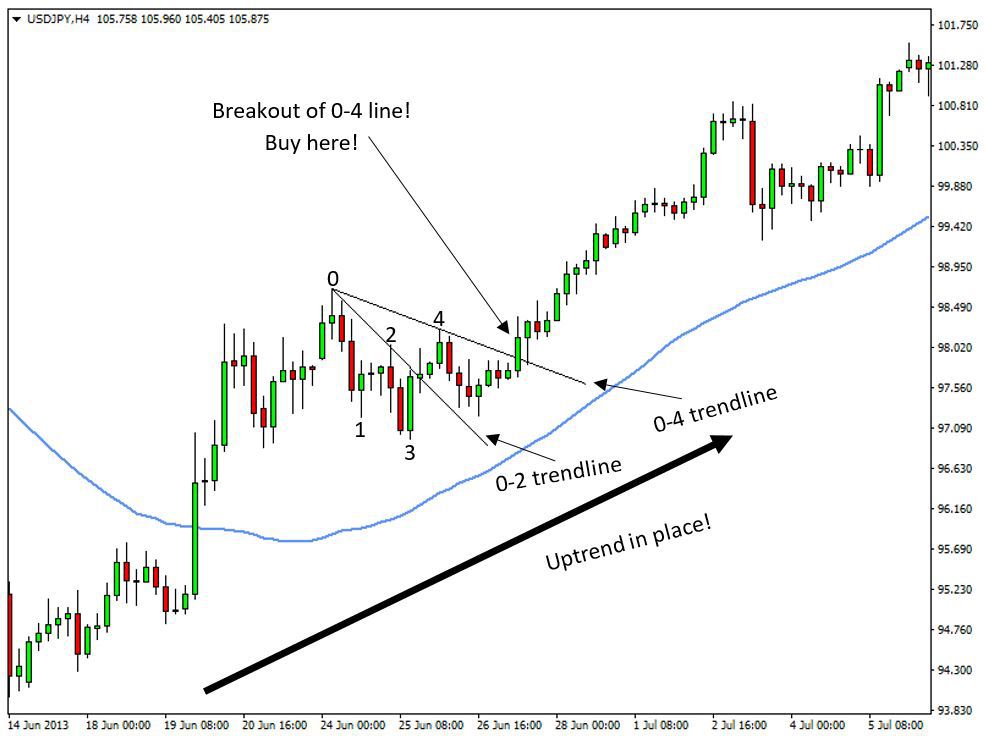
In essence, the strategy consists of drawing two trendlines and then analyzing how they interact with each other and with price.
Those 2 trendlines are the 0-2 and the 0-4 line, as John calls them.
• Point 0 is always the starting point of the pullback. So, that would be the high in an uptrend and the low in a downtrend.
• Point 1 is the ending point of the first swing inside of the pullback.
• Point 2 is the ending point of the second swing inside of the pullback.
• Point 3 is the ending point of the third swing inside of the pullback.
• Point 4 is the ending point of the fourth swing inside of the pullback.
Now, to get the 0-2 and 0-4 line all we need to do is connect the respective points inside of the pullback. It doesn’t matter which swing point is higher or lower, just connect the 0-2 and the 0-4 points.
So, after drawing the two lines we can get a sense of the strength of the pullback by analyzing the trendlines.
If line 0-4 is steeper then the pullback has momentum and may turn into a complete reversal of the larger trend. Don’t enter on the breakout of line 0-4.
If line 0-2 is steeper then the pullback is weak and the larger trend is more likely to resume. Enter on the breakout of the 0-4 line in the direction of the larger trend.
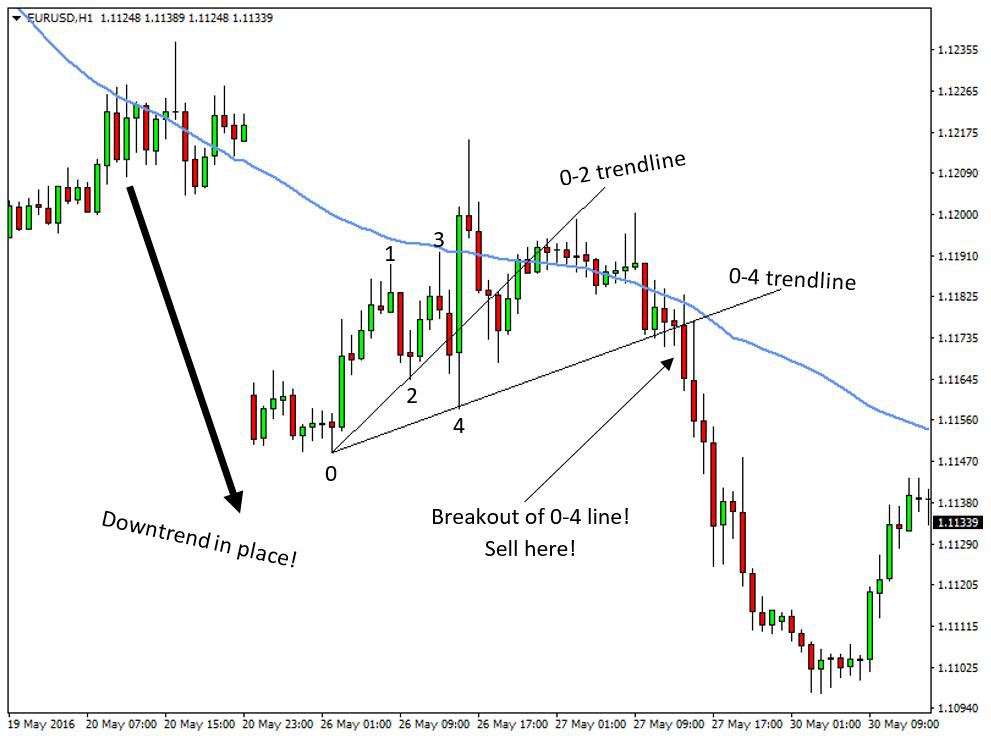
Let’s look at a few examples so that you can better understand this strategy. First an example of the trendline theory in a downtrend on the EUR/USD pair.
To determine the trend on this chart, we are using a 50-period simple moving average represented with the blue line. The price is clearly below of the MA for most of the time and the MA is sloping down indicating strength of the larger trend.
• The start of the pullback is the swing low of the initial down move on the left and it’s marked with the number 0 on the chart.
• In line with John Hill’s trend line theory, the first swing high inside of the pullback is marked with number 1 on the chart
• The first swing low inside of the pullback is marked with number 2 on the chart
• The second swing high inside of the pullback is marked with number 3 on the chart
• The second swing low inside of the pullback is marked with number 4 on the chart
類似した注文
Hello, I need a custom Expert Advisor (EA) for MetaTrader 5 that implements a specific trend-following and reversal strategy using trailing pending orders. Here is the exact logic I need: 1. Initial Entry: The EA should open a Market BUY position (or I can open it manually, please include an option for both). 2. Trailing Sell Stop: As soon as the BUY position is open, the EA must place a SELL STOP pending order at a
i have back test video of exe5 file and need to develop ea mql mt5 source file experienced developers needed...i send video who are interested.... this is not martingale method
I’m looking for an experienced developer to build a fully automated XAUUSD scalping EA for MT5. Requirements: * Fast entries targeting small, profitable moves after trading costs. * Configurable fixed-target and trailing-stop modes. A $1 gold price move can trigger profit protection instead of closing the trade. * Once the profit trigger is reached, move the stop to cover costs and lock in a small net profit, then
I want to create an EA that will take trades according to a trading zone condition. The logic will start with the identification of a trading zone for BUY and SELL in the EA. After the trading zone has been identified, then the EA will use the current time frame prices to determine if the market will be a BUY or SELL. The market will be a BUY if the low price range goes above the lowest price after the installation
I have an existing compiled MT5 Expert Advisor (.ex5) for XAUUSD scalping. I need a developer to build a bridge that connects my existing EA to a broker’s FIX API, allowing its trading signals to execute orders directly through FIX instead of the standard MT5 trade server. I do not need a new trading strategy or a new EA. Please confirm whether this is technically possible without the EA source code, and explain your
I am looking for an experienced MQL5 developer and trader to develop a non-repainting scalping indicator for MT5 , designed for the M5 and M15 timeframes. Instruments I Trade: GainX 400 GainX 600 PainX 400 PainX 600 My Main Requirement: Signal Accuracy I do not need another basic indicator that simply displays BUY/SELL signals with Stop Loss and Take Profit levels. I already have several indicators, but their signals
Project Description: I need an MQL5 Expert Advisor built based on a precise Smart Money Concepts (SMC) multi-timeframe strategy. The bot must analyze the 1-Hour chart for institutional bias and execute trades on the 3-Minute chart following strict structural rules. 1. Inputs & Parameters (Customizable) - Risk Model: Fixed dollar risk of $20.00 for every $100.00 of account balance (20% per trade for personal capital
Hello, I want to create a custom Expert Advisor (EA) for MetaTrader 5 based on 3 main confirmations: Market Structure & Price Action: Identify high time-frame trend direction (HL/LH). Chart Pattern: Detect classic continuous/reversal patterns (e.g. Cup and Handle, Double Bottom/Top) on trading timeframe. Volume Profile (PoC): Confirm entry when price breaks/retests the Point of Control (PoC) level. Risk Management &
I am looking for a highly skilled trading strategist and MQL5 developer with genuine experience in researching, designing, testing, and implementing systematic trading strategies. My primary interest is XAUUSD (Gold), although proven experience with other financial markets is also welcome. I am not looking for someone who simply converts trading rules into code. I want to identify a professional who understands
We’re looking for an investment partner to help fund AegisGoldAIPro , an algorithmic trading platform being developed for MetaTrader 5, initially focused on gold. We’re building a modular system that combines market-structure analysis with planned AI-assisted decision support, risk controls, and automated execution. What we are building is not just a basic trading robots that depend on only one indicator or strategy
 すべての注文
 ルール
ルール