Axis 7even Specialist
The complete seven-market Axis portfolio plus a dedicated Nasdaq intraday specialist
Everything the flagship proves, plus one more market most competitors never touch. Same discipline, wider reach.
Everything in the flagship, plus a dedicated Nasdaq intraday engine.
Axis 7even Specialist combines the complete seven-market H1 portfolio of Axis 7even with an additional purpose-built Nasdaq-100 specialist engine operating on USTEC / US100. The Nasdaq module is not a cosmetic eighth symbol: it has its own session framework, adaptive risk state, trade management and broker-compatibility gate inside the same coordinated account.
The result is two distinct trading layers working together: the seven-market H1 core and a dedicated Nasdaq intraday specialist.
For questions about installation, technical specifications, compatibility, or general product support, please visit our MQL5 public support channel: CLICK HERE
The Seven-Market Core
EURUSD, USDJPY, GBPJPY, EURAUD, USDCAD, XAUUSD and WTI are monitored by the same market-specific H1 architecture used by Axis 7even. The engines are selective by design and respond to the market behaviour appropriate to each instrument rather than forcing one universal strategy across the portfolio.
What the Nasdaq Specialist Adds
• A fixed New York session window: 09:30–16:30 entry, 17:00 mandatory exit.
• Dedicated entry, confirmation and trade-management logic.
• Its own adaptive stop-loss buffer that tightens or loosens based on recent USTEC-specific outcomes.
• Its own warmup and defensive risk states — layered on top of, not instead of, the account-wide protection every Axis 7even edition carries.
Adding the specialist module does not loosen the account-wide guardrails. It adds another independent strategy layer while remaining subject to the same broader portfolio-protection architecture.
Historical Evidence for the Specialist Architecture
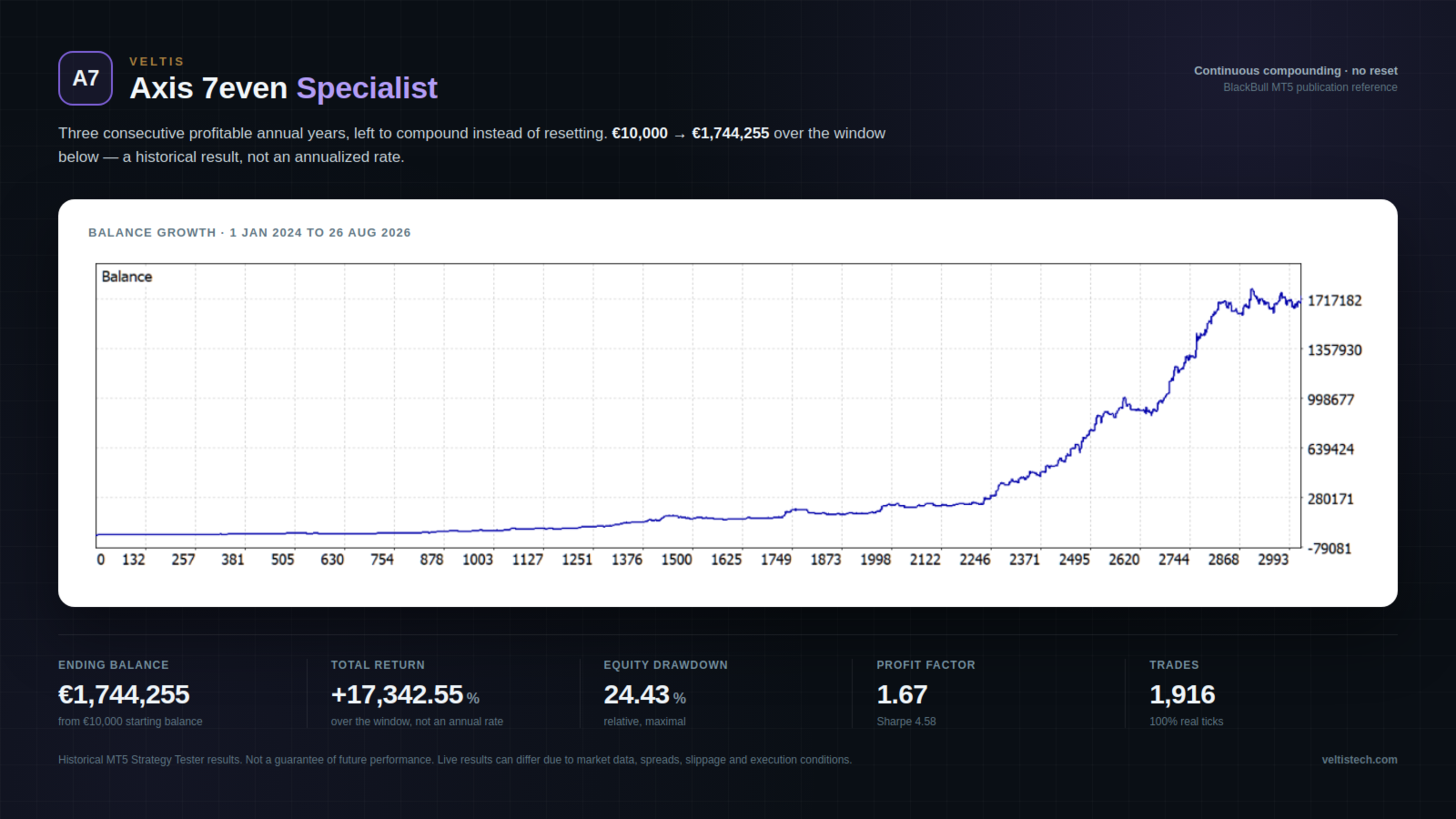
Because the Plus architecture depends on validated Nasdaq real-tick history, its standardized commercial comparison window begins in 2024. Annual Strategy Tester research from a EUR 10,000 starting balance produced:
• 2024: +443.78%
• 2025: +319.43%
• 2026 (to 26 Aug): +940.43%
That represents two completed profitable calendar years plus a profitable 2026 YTD period through 26 August. The figures describe historical tester behaviour and are not a forecast of future performance.
What Continuous Compounding Produced Historically
Over 1 Jan 2024 to 26 Aug 2026, continuous percentage-based sizing took the historical EUR 10,000 starting balance to EUR 1,744,255 in the standardized portfolio test. This is a historical multi-year result over roughly 2.7 years, not an annualized rate and not a projection.
Cross-Broker, Cross-Year — Not One Feed
Across the same 2026 test window, Axis 7even Core remained profitable on BlackBull, Pepperstone, IC Markets and FxPro. Net profit ranged from EUR 55,108 to EUR 64,005, Profit Factor from 1.72 to 1.82, and trade count from 200 to 208.
For the longer continuous 2024–2026 window, BlackBull and Pepperstone both remained strongly profitable where sufficient long-window history was available. The different final balances are disclosed because compounding amplifies even modest differences in broker data and execution.
Not Locked to One Nasdaq Feed
Axis 7even Specialist was developed and extensively validated with BlackBull as the principal reference environment, then subjected to additional FxPro comparison and independent Nasdaq futures market-data analysis. The objective was not to claim identical broker trades, but to determine whether compatible broker feeds reflect the same underlying Nasdaq market structure.
• 23 exact same-time, same-direction USTEC entries in the comparable BlackBull/FxPro sample; 25 matched within five minutes.
• 93.5% median zone overlap across broker-only entries in the focused diagnostic sample.
• 0.9996 correlation between the BlackBull USTEC feed and independent NQ futures data at the five-minute level.
This evidence supports signal and market-structure portability on compatible instruments. It does not mean every broker will generate identical trades or identical profit.
Nasdaq Compatibility Is Checked, Not Assumed
Nasdaq CFD and futures-style contracts can differ substantially between brokers. Axis 7even Specialist therefore validates the resolved instrument before enabling the specialist module. Minimum lot size, volume step, stop-distance structure, profit currency, contract/tick data, M1 history and session mapping are among the conditions that matter.
If the available Nasdaq contract is unsuitable, the strategy is not altered simply to force compatibility. The specialist module is prevented from operating on an incompatible instrument.
Portfolio-Level Risk Management
The Axis family uses a simplified three-profile portfolio risk framework. STANDARD represents the default full tested allocation.
• CONSERVATIVE — 0.50×
• MODERATE — 0.75×
Adaptive Specialist Risk + Portfolio Protection
The Nasdaq specialist retains its own internal adaptive risk behaviour while remaining subject to the overall Axis portfolio-protection architecture: per-engine health, portfolio-wide drawdown throttle, and a latched account-level shutdown. No automated protection mechanism can guarantee a fixed maximum loss under all live-market conditions.
• Per-engine health for the H1 strategies.
• Portfolio Core drawdown throttling across the H1 basket.
• Account-level staged protection and new-entry shutdown.
• USTEC-specific adaptive warmup and defensive risk states on top of the account-wide protection.
No Grid. No Martingale.
Axis 7even Specialist does not depend on Grid recovery or progressive loss-based lot multiplication. The portfolio is built around defined strategy logic, percentage-based risk and controlled position management.
One-Chart Portfolio Operation
Despite coordinating eight markets and two different trading layers, Axis 7even Specialist is designed for single-chart operation. The complete portfolio, startup validation and operational status are managed through one Expert Advisor.
Important Nasdaq Compatibility Note
The seven-market core can operate across a wider range of conventional Forex/CFD environments. The Nasdaq specialist has stricter requirements because broker contract specifications vary considerably — a broker using an unsuitable minimum lot size, volume step, stop-distance structure or contract specification may not be compatible. Axis checks these conditions automatically rather than changing the strategy simply to force compatibility with an unsuitable instrument.
- Recognized Nasdaq-100 / USTEC-family symbols: examples include USTEC, NAS100, US100, USA100, NDX100, NQ100, NASDAQ100, USTECH, TECH100 and compatible NQ-style front/futures contracts.
- Minimum lot size: 0.01 lot or smaller (automatically recognized by EA – if not initialization fails)
- Volume step: 0.01 lot or smaller (automatically recognized by EA – if not initialization fails)
- Minimum stop-distance restriction: maximum 20 actual Nasdaq index points (automatically recognized by EA – if not initialization fails)
Extended Dashboard
• Balance and Equity, Drawdown and Open P/L
• Market-Level Status and Individual Engine States
• Portfolio Protection and Nasdaq Specialist Status
Why Traders Choose Axis 7even Specialist
Axis 7even Specialist was built around a clear philosophy: the full coordinated portfolio, plus a specialist engine for a market most competitors never touch.
Its core advantages include:
• Everything in the full seven-market portfolio, plus a dedicated Nasdaq-100 intraday engine
• The strongest annual case in the family — Two completed profitable annual test years plus a profitable 2026 YTD period
• No Grid, no Martingale and no hidden recovery averaging.
• Every position protected by layered risk controls, including the USTEC engine's own adaptive stop-loss
• One position per market symbol, enforced in code — not just described in marketing copy
• Cross-broker and independent Nasdaq-market reference evidence for the specialist module.
• Adaptive specialist risk layered on top of portfolio-wide protection.
• Fully automated execution with no manual intervention required
• Three predefined risk profiles: Conservative, Moderate, Standard
• Plug & Play installation with tested default settings
• The most extensive published evidence set in the entire family
Axis 7even Specialist takes the complete Axis portfolio and adds a genuinely separate Nasdaq specialist — same discipline, broader opportunity set, and stricter compatibility control where the instrument demands it.
How It Works
Axis 7even Specialist was designed to make disciplined, dual-layer trading accessible without requiring constant manual supervision. Here is how it operates:
• Plug & Play installation — attach Axis 7even Specialist to one H1 chart (typically USDJPY H1), select a risk profile, and let the EA handle the rest.
• Optimized default configuration — no manual parameter optimization is required for standard operation.
• Continuous independent monitoring — each of the seven H1 markets is analysed by its own dedicated engines, while the USTEC specialist monitors its own New York session separately.
• Selective execution — a position opens only when a specific engine's own qualifying conditions are met.
• Layered risk from entry — per-engine health, portfolio-level throttle, account-level protection, and the USTEC engine's own adaptive risk state are all active from the first trade.
• One position per symbol — enforced in code, not just described in marketing copy.
• Automatic broker-symbol resolution — the EA identifies and validates compatible instruments, including the Nasdaq contract, before trading.
• No emotional decisions — every action follows predefined, tested logic.
Inputs
Risk Profile
• InpRiskProfile — Conservative (0.50×), Moderate (0.75×) or Standard (1.00×, full tested sizing). Scales the entire portfolio's risk allocation. Default: Standard.
Notifications
• InpEnablePortfolioEmailAlerts — enables or disables email notifications for portfolio-level drawdown alerts. Default: true.
Display
• InpShowDashboard — shows or hides the on-chart dashboard. Default: true.
• InpDashboardScalePercent — dashboard size, 70–150% supported; auto-fits to chart width. Default: 100.
Advanced — Symbol Overrides (leave blank for Auto)
• InpAutomaticSymbolDetection — recommended on; lets Axis resolve broker-specific symbol names automatically. Default: true.
• EURUSD / USDJPY / GBPJPY / EURAUD / USDCAD / XAUUSD / WTI /NASDAQ symbol override — manual override fields, needed only if automatic detection cannot resolve your broker's specific symbol naming.
General Requirements
- Platforms: MetaTrader 5
- Markets: EURUSD, USDJPY, GBPJPY, EURAUD, USDCAD, XAUUSD, WTI (H1) + USTEC-NASDAQ(M1)
- Recommended broker: Broker with tight spreads, and a compatible Nasdaq-100 instrument (see the compatibility note above)
- Recommended balance and Leverage: 5000 starting balance, 1:100 leverage
- Read Important Nasdaq Compatibility Note for NASDAQ above
- Account type: Any — the EA's own one-position-per-symbol rule makes it safe on either Hedging or Netting accounts
- VPS: mandatory for uninterrupted 24/5 operation
LIMITED LAUNCH ALLOCATION — 30 LICENSES
Axis 7even Specialist will be released with a limited initial allocation of licenses at the launch price. Once that allocation is sold, pricing will be reviewed together with the developing live-trading record and operating history. If the additional evidence continues to support the system's historical profile, subsequent license allocations may be offered at a higher price. The initial allocation therefore rewards early adopters for committing while the public live record is still younger; it is not a promise of future performance
RISK DISCLOSURE
Historical backtests and technical validation describe historical behaviour and implementation consistency; they do not guarantee future performance. Live results can differ because of market data, spreads, slippage, liquidity, broker execution, contract specifications, leverage, margin conditions and future market regimes. Portfolio protection is designed to restrict additional exposure during severe drawdown conditions, but no automated mechanism can guarantee a fixed maximum loss.

 🔷 𝐕𝐄𝐋𝐓𝐈𝐒 — 𝐏𝐑𝐎𝐅𝐄𝐒𝐒𝐈𝐎𝐍𝐀𝐋 𝐀𝐋𝐆𝐎𝐑𝐈𝐓𝐇𝐌𝐈𝐂 𝐓𝐑𝐀𝐃𝐈𝐍𝐆 𝐒𝐘𝐒𝐓𝐄𝐌𝐒